Creative Minds 𖹭 Happy Hearts

Making a Model of a Neuron, Labeled Parts Included
Pipe cleaners become dendrites and beads map the myelin sheath when making a model of a neuron gives your student a hands-on reason to actually remember these parts.
Making a model of a neuron is the focus of this lab sheet, which walks grades 5-8 homeschoolers through building a three-dimensional, labeled neuron using clay, pipe cleaners, beads, and cardstock. The sheet identifies six key structures, including dendrites, cell body, nucleus, axon, myelin sheath, and axon terminals, and gives the function of each in a reference chart students can consult while they build. A color photo of a completed example model is included so your student has a clear target before picking up any materials.
This lab fits naturally into a unit study on the nervous system or human body systems, and it stands on its own as an introduction to cell structure and signal transmission. The seven-step procedure guides your homeschooler from forming the soma to labeling the finished model, and the reflection section asks three open-ended questions that push toward genuine understanding rather than rote recall. An extension idea prompts further research into how neurons send signals across a synapse, giving advanced students a logical next step.
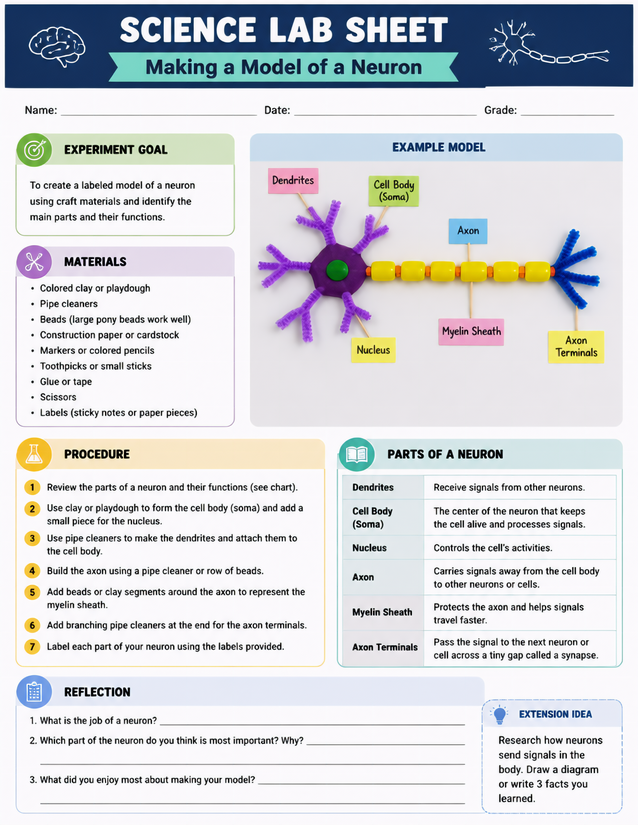
Pipe cleaners, beads, and clay bring making a model of a neuron to life for grades 5-8 homeschoolers. Download and print instantly.
Getting Started with Making a Model of a Neuron

Usage Notes
Colored clay or playdough, pipe cleaners, large pony beads, construction paper, markers, toothpicks, glue or tape, and scissors are all the materials listed. Every item on that list is a household or craft-store staple, so no specialty science supply orders are needed. Scissors and toothpicks are the only sharp tools involved, worth a quick reminder for younger students working independently.

Printing Tips
Card stock at 65 lb holds up better than copy paper when students are referencing the sheet with clay-covered hands. A loose sheet on a clipboard keeps it accessible at a craft table, though it also slides neatly into a three-ring lab notebook once the model is complete.