Creative Minds 𖹭 Happy Hearts

Making a Model of a Reflex Arc, Clothespin and String
Squeeze a clothespin and watch the message travel. Making a model of a reflex arc turns an abstract nervous system concept into something your student can hold, label, and test in an afternoon.
Making a model of a reflex arc walks your student through the five-part pathway the body uses to respond to harmful stimuli before the brain even processes what happened. The sheet covers receptor, sensory neuron, integration center, motor neuron, and effector, and asks students in grades 5 to 8 to build a physical model using a clothespin, two lengths of string or yarn, a small cardboard box, and a paper cup, then observe what changes when they squeeze harder or lengthen the strings.
This lab fits naturally into a unit study on the nervous system or human body systems, and it pairs well with any lesson on involuntary versus voluntary responses. By completing the observation questions and the fill-in conclusion section, your homeschooler demonstrates both procedural understanding and the ability to explain why reflex arcs matter for survival, making it a strong standalone assessment piece or a hands-on entry point before moving into more detailed neuroscience reading.
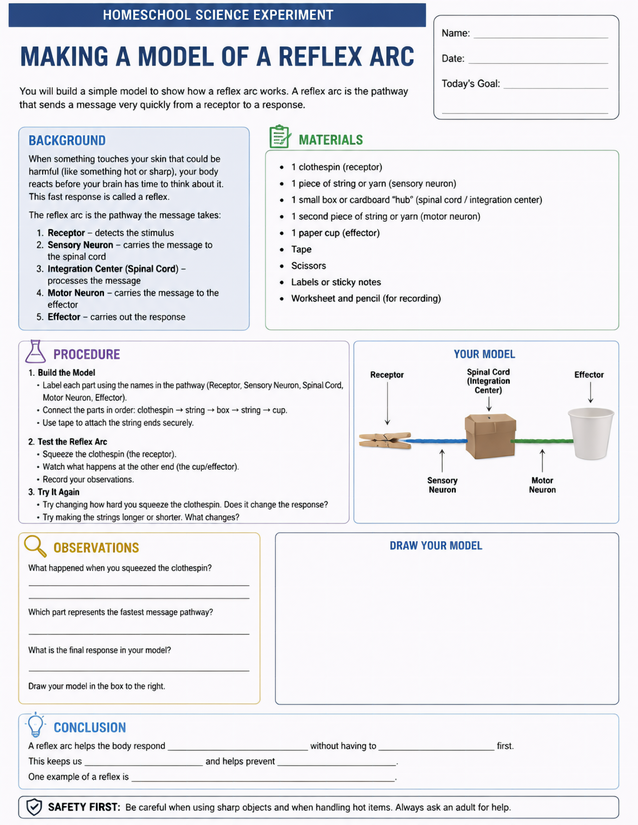
Grades 5-8 homeschoolers explore nervous system pathways by making a model of a reflex arc using everyday household materials.
Recording Results for Making a Model of a Reflex Arc

Usage Notes
Almost every material on this sheet is a true household item: a clothespin, string or yarn, a small cardboard box or folded cardboard, a paper cup, tape, and scissors. Labels or sticky notes are the only specialty item, and a plain pen works just as well. The sheet includes a Safety First reminder to use caution with scissors and to ask an adult for help with any sharp objects.

Printing Tips
Print on standard copy paper so students can write comfortably in the observation lines and conclusion blanks during the build. A loose sheet on a clipboard works well here since students will be moving the physical model around while recording, and a second copy printed on card stock makes a clean display diagram once the experiment is done.