Creative Minds 𖹭 Happy Hearts

Making a Model of Lymph Node Function, Grades 5-8
Coffee filters, plastic cups, and ground pepper reveal exactly how making a model of lymph node function turns immune system biology into something your student can pour, watch, and hold in their hands.
Making a model of lymph node function asks your student to build a working filter system from a coffee filter secured inside a plastic cup with a rubber band, two short lengths of tubing or straws, and a second cup of water mixed with ground pepper or glitter to stand in for lymph fluid carrying debris. Students pour the “dirty” fluid in one side and observe what the filter traps versus what exits clean on the other side. The sheet is designed for grades 5-8 and walks through the lymphatic system background, a labeled model diagram, a five-step procedure, and space to compare input and output fluid.
This lab fits naturally inside a human body unit study covering the immune system, and it pairs well with lessons on organs that filter or clean (pairing it alongside a kidney or blood unit works particularly well). Your homeschooler records observations on what the filter trapped, answers three reflection questions connecting the model to real immune function, and reads a “Think Like a Scientist” note that draws the honest line between the model and actual immune cell behavior. Making a model of lymph node function gives students a concrete, repeatable demonstration they can describe and defend in their own words.
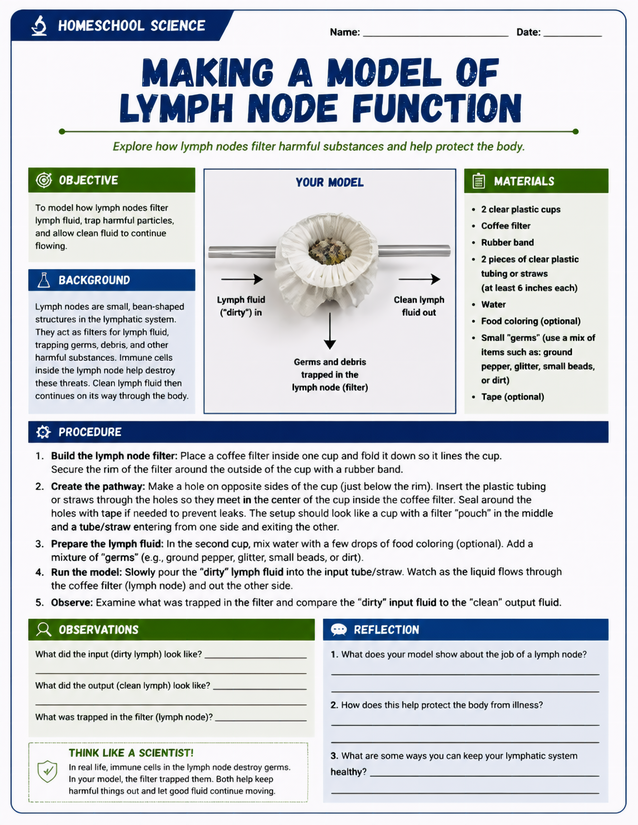
Grades 5-8 homeschoolers explore making a model of lymph node function using a coffee filter, tubing, and everyday materials.
Exploring Making a Model of Lymph Node in Your Homeschool

Usage Notes
Every material on this sheet is a household item or a grocery store staple. The coffee filter, rubber band, plastic cups, and straws are the core build; ground pepper, glitter, or small beads stand in for germs and debris. Food coloring is listed as optional but helps your student see the contrast between dirty input and clean output. No heat or chemicals are involved, so safety setup is minimal beyond keeping the work area above a tray to catch spills.

Printing Tips
A single sheet on 24 lb copy paper gives your student enough surface to write comfortably in the observation and reflection lines. Slip it inside a plastic page protector in a science binder after the experiment is complete, or punch and bind it directly into a dedicated immune system unit notebook.