Creative Minds 𖹭 Happy Hearts

Making a Model of the Nitrogen Cycle, Hands-On Lab Sheet
Nitrogen is everywhere, but your student probably cannot see it moving. Making a model of the nitrogen cycle puts that invisible process into a shoebox they can label, point to, and explain.
Making a model of the nitrogen cycle asks students to construct a physical diorama showing how nitrogen moves between the atmosphere, soil, plants, decomposers, and bacteria. The sheet guides grades 5-8 through a full scientific method sequence: a driving question about living and nonliving parts of the environment, a written hypothesis, a nine-step build procedure, an observation prompt, and separate analyze and conclude sections. A reference key on the right side of the sheet defines each stage, including atmospheric fixation, assimilation, ammonification, nitrification, and denitrification, so students can label their model accurately as they build.
This lab fits naturally into a life science or earth science unit study on biogeochemical cycles, and it pairs well with lessons on ecosystems, soil biology, or plant nutrition. A student who completes this sheet demonstrates not only the sequence of nitrogen transformations but also the ability to distinguish biotic from abiotic system components, a key critical thinking skill the analyze section asks them to apply directly. The think-further prompt at the bottom, about how farming and pollution affect the cycle, opens the door to an extended discussion or follow-up research project.
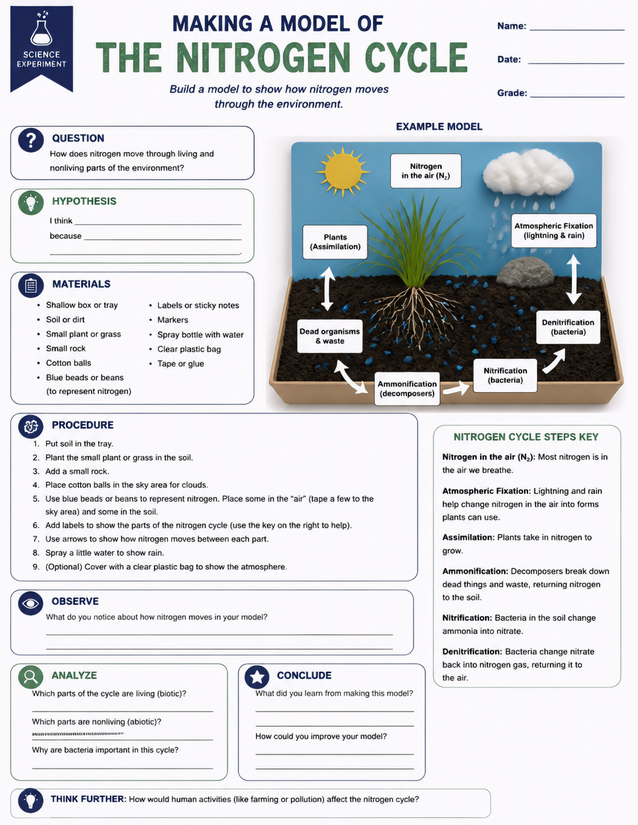
Grades 5-8 homeschoolers explore making a model of the nitrogen cycle using everyday household materials. Includes hypothesis, procedure, and analysis sections.
Investigating Making a Model of the Nitrogen Cycle

Usage Notes
Most materials on this sheet are household items: soil or dirt, a shallow box or tray, a small plant or grass clipping, a rock, cotton balls, blue beads or dried beans, markers, sticky notes, a spray bottle with water, a clear plastic bag, and tape or glue. Nothing here requires a specialty science supplier. The sheet does not flag specific safety concerns, but supervising younger students when handling soil and reminding them to wash hands after the build is a sensible precaution.

Printing Tips
A single loose sheet on a clipboard works well here since students will be handling soil and water during the build. If you want a keepsake record, print on 24 lb paper and slip the completed sheet into a clear page protector for the lab notebook once it dries.