Creative Minds 𖹭 Happy Hearts

Making a Model of the Rock Cycle, Clay and Cardboard Base
Four clay rock types, five labeled process arrows, one circular base: making a model of the rock cycle gives your student a hands-on map of how magma becomes igneous rock and back again.
Your student builds a circular clay model that shows all four parts of the rock cycle: magma, igneous rock, sedimentary rock, and metamorphic rock. The sheet walks through five processes, including cooling, weathering and erosion, compaction and cementation, heat and pressure, and melting, each one labeled with a directional arrow on the finished model. A Think and Answer section asks your student to explain how each transition happens, making it suitable for grades 4 through 7.
Making a model of the rock cycle fits naturally into an earth science unit study on geology or mineral formation. It works as a standalone hands-on lesson or as the anchor activity before your student moves into sediment layer studies or plate tectonics. Completing the model demonstrates understanding of cyclical processes in earth science, not just the names of rock types but the forces that transform one into another.
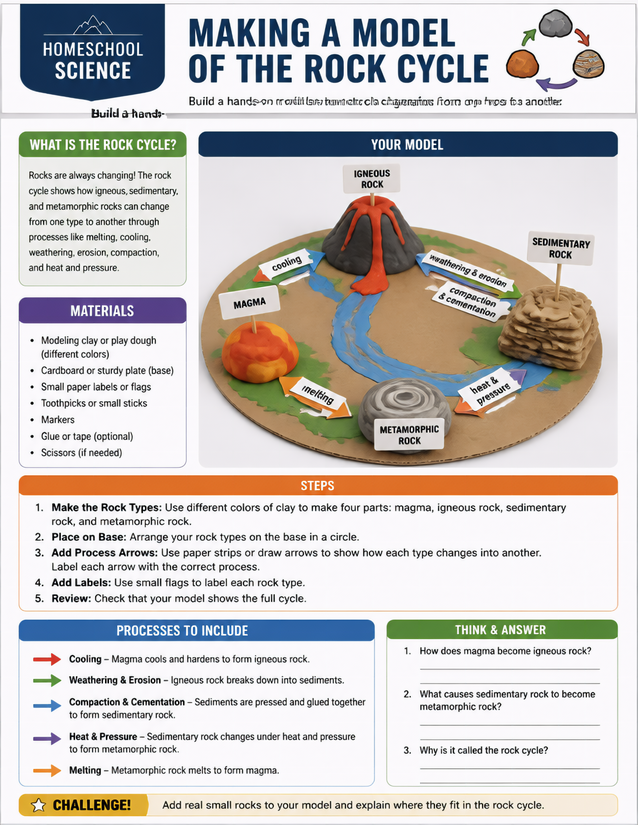
Grades 4-6 homeschoolers explore making a model of the rock cycle using clay, cardboard, and labeled process arrows. Instant download.
Getting Started with Making a Model of the Rock Cycle

Usage Notes
Modeling clay or play dough in multiple colors handles all four rock formations, and a cardboard or sturdy paper plate serves as the base. Toothpicks, small paper flags, and markers for labels are household staples. No heat or chemicals are involved, so this is a safe independent project for upper elementary students.

Printing Tips
A 65-lb cardstock copy holds up better than copy paper if your student presses hard while writing in the Think and Answer section. Slide the finished sheet into a clear page protector inside a science lab notebook, or keep it loose on the work surface as a reference while building the clay model.