Creative Minds 𖹭 Happy Hearts

Making a Simple Electroscope to Detect Static Charge
Aluminum foil leaves hanging inside a mason jar tell your student exactly when static charge is present. Making a simple electroscope turns that invisible force into something you can watch spread apart.
Making a simple electroscope is the goal of this lab sheet, which walks your student through building a detector from a clear glass jar, a large metal paper clip, aluminum foil rectangles, tape, and a straw or pencil. The observations table asks students to record what happens to the foil leaves across five distinct tests: nothing near the electroscope, a rubbed balloon brought close, a rubbed balloon touching the top, rubbed wool cloth near the top, and rubbed hair near the top. A reflection prompt asks what they learned, and a Think Like a Scientist question pushes them to explain why like charges cause the leaves to repel. This lab suits grades 4 through 7 and fits naturally into a unit study on electricity or static charge.
The sheet stands alone as a one-session experiment, but it also pairs well with a broader electricity unit covering circuits or conductors. Challenge ideas printed on the sheet extend the investigation, asking your homeschooler to try a comb, ruler, or plastic bag as the charged object, test detection distance, and vary foil leaf size to see whether it changes the spread. Completing the observations table and the reflection demonstrates that your student can connect a physical observation to the underlying principle of charge repulsion, which is a foundational electricity concept.
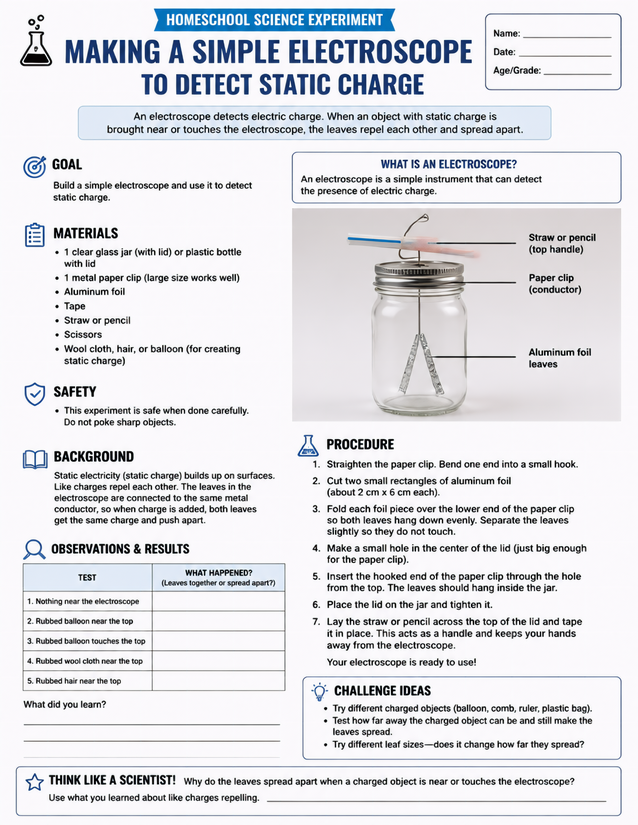
Grades 4-7 homeschoolers build a jar electroscope and test static charge with this making a simple electroscope lab sheet.
Investigating with Making a Simple Electroscope

Usage Notes
Every material on this sheet is a household item. You will need a clear glass jar with a metal lid, a large paper clip, aluminum foil, tape, scissors, and a straw or pencil. A wool cloth, balloon, or someone’s hair provides the static charge for testing. The safety note on the sheet flags one consideration: do not poke sharp objects through the lid, so an adult should handle the step of making the hole in the metal lid before handing it to your student.
Printing Tips
Twenty-four-pound paper holds up better than standard copy weight when students are writing in the observation table during an active experiment. A loose sheet on a clipboard works well here since the jar and charged objects need to move around the workspace freely.