Creative Minds 𖹭 Happy Hearts

Making a Simple Lie Detector Using Galvanic Skin Response
Sweat conducts electricity, and making a simple lie detector turns that biology fact into a measurable experiment your student can run on the whole family.
Making a simple lie detector gives grades 6-9 homeschoolers a hands-on entry point into biophysics, specifically how stress and arousal change the skin’s electrical conductance. The sheet walks students through building a galvanic skin response circuit with zinc and copper disks acting as a small battery, two finger electrodes taped to the index and middle finger, and an analog microammeter reading current in microamps. Students establish a relaxed baseline, then test reactions to neutral thoughts, exciting memories, and truth-or-lie questions while logging meter readings in a structured data table that includes columns for situation, answer type, meter reading, and personal notes.
The experiment fits naturally into a unit study on the human nervous system, human biology, or basic electricity, and it pairs well with lessons on the electrochemical signals the body uses to respond to stimuli. Completing the sheet asks your student to move beyond observation into analysis: the Think and Discuss section prompts them to evaluate accuracy, consider confounding variables like nervousness or embarrassment, and propose improvements to the setup. That level of scientific reasoning, forming a hypothesis, collecting controlled data, and critiquing results, is precisely what makes making a simple lie detector more than a novelty project.
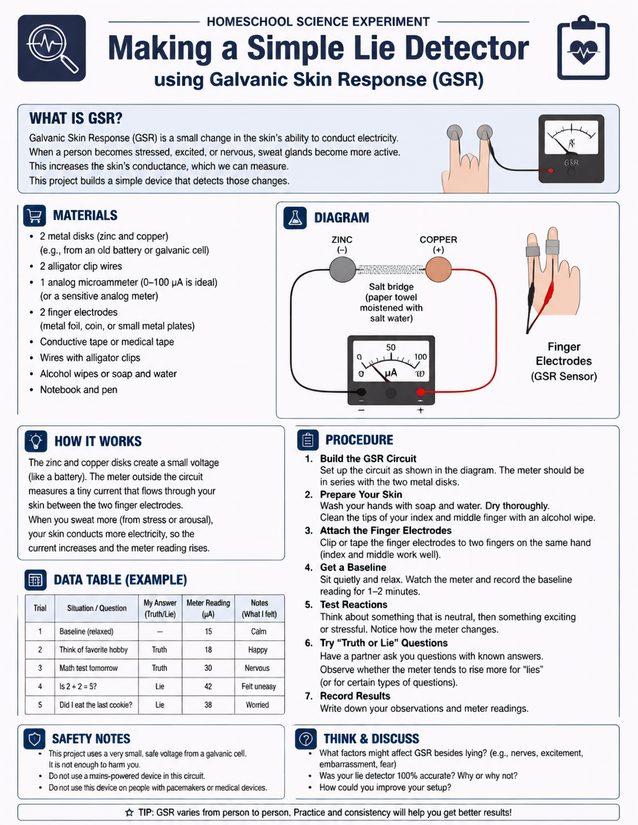
Grades 6-9 homeschoolers explore making a simple lie detector with galvanic skin response. Finger electrodes, a microammeter, and household supplies included.
Investigating with Making a Simple Lie Detector and GSR

Usage Notes
Most materials here are household or low-cost specialty items. Zinc and copper disks can come from old batteries or a galvanic cell, and the sheet suggests metal foil or coins as finger electrode substitutes. The one specialty item is the analog microammeter rated 0-100 µA, which is not a standard kitchen-drawer find but is inexpensive online. Safety notes on the sheet are clear: the galvanic cell voltage is too small to cause harm, but the sheet explicitly warns against mains-powered devices and flags that students with pacemakers or medical devices should not participate.

Printing Tips
Cardstock is worth the extra weight here. Students will be writing meter readings in real time while electrodes are taped to their fingers, so a stiff sheet on a clipboard holds up better than flimsy copy paper. Slip a finished sheet into a clear protective sleeve if you want to keep it as part of a lab notebook.