Creative Minds 𖹭 Happy Hearts

Making a Water Clock (Clepsydra) Lab Sheet
Ancient engineers used dripping water to track time, and making a water clock clepsydra puts that same principle in your student’s hands with two plastic bottles and a push pin.
Making a water clock clepsydra asks your student to fill an upper bottle with water, pierce a small hole in the cap, and invert it over a lower bottle so water drips at a steady rate. Students record the starting and ending water level in milliliters across five measured intervals, log the time elapsed in seconds for each interval, and calculate an average time per interval in the data table provided. Four analysis questions guide your homeschooler to evaluate whether intervals were consistent, identify variables that affected drip speed, propose improvements for accuracy, and connect the experiment to ancient history. This lab suits grades 4 through 7.
The sheet works well as a standalone unit study activity or as an anchor experiment inside a broader physics or ancient civilizations unit. When your student completes all five intervals and works through the analysis questions, they demonstrate an understanding of controlled variables, measurement precision, and the engineering idea that a steady physical process can serve as a clock. The calibration challenge at the bottom pushes further inquiry by asking whether hole size can be tuned to produce exactly one-minute intervals.
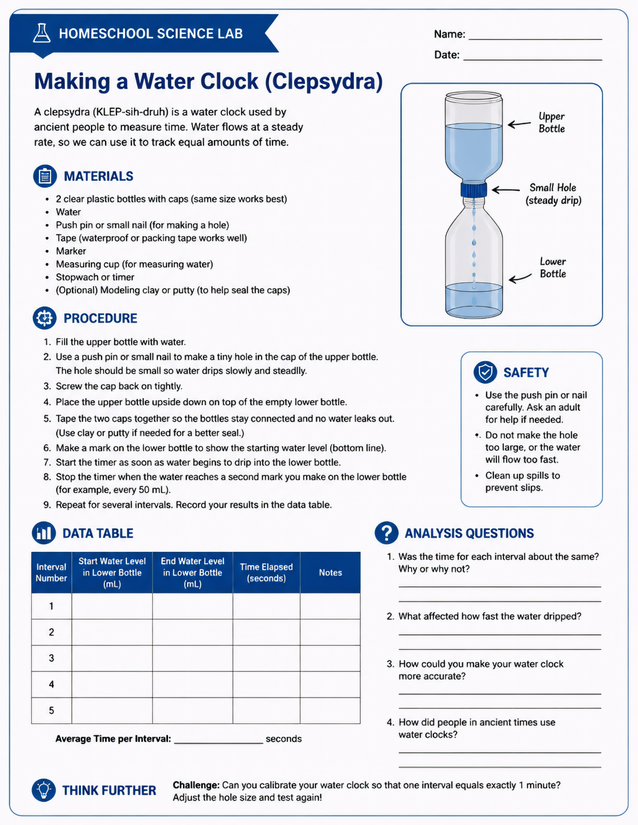
Ancient timekeeping comes alive when making a water clock clepsydra for grades 4-7. Includes data table and analysis questions.
Investigating with Making a Water Clock Clepsydra

Usage Notes
Nearly every material on this list is already in a typical home: two same-size plastic bottles with caps, water, a marker, a measuring cup, and a stopwatch or timer. The one item that needs care is the push pin or small nail used to pierce the bottle cap. The sheet includes a dedicated safety note reminding students to ask an adult for help with that step and to keep the hole small so flow stays slow and steady. Optional modeling clay or putty helps seal the joined caps if tape alone does not prevent leaking.

Printing Tips
A single sheet on 24-pound copy paper gives students enough surface stability to write in the data table while the experiment is running. Slip it into a plastic page protector on a clipboard to keep it dry if water splashes during setup, then remove it for writing.