Creative Minds 𖹭 Happy Hearts

Making Bath Bombs Lab Sheet, Acid-Base Reaction
Fizzing, bubbling, and a bath bomb dissolving in real time: making bath bombs lab sheet turns a kitchen chemistry project into a structured acid-base investigation your student records step by step.
Your student starts by writing a hypothesis about what happens when a bath bomb hits water, then follows nine numbered steps to mix baking soda, citric acid, cornstarch, and Epsom salt, pack the mold, let it dry for 24 hours, and drop it into a clear container of warm water. The observation table prompts timed entries at 0 seconds, 15 seconds, 30 seconds, one minute, two minutes, and dissolution, capturing what the student sees, hears, smells, and notices. Designed for grades 3-6, this making bath bombs lab sheet gives homeschoolers a concrete, sensory record of an acid-base reaction.
The sheet fits naturally into a chemistry unit study on chemical reactions, pH, or states of matter, and it works equally well as a standalone hands-on experiment. Two conclusion questions ask what happened when the bath bomb was placed in water and whether the results supported the hypothesis, pushing your student to connect observation with scientific reasoning rather than simply describing what they saw.
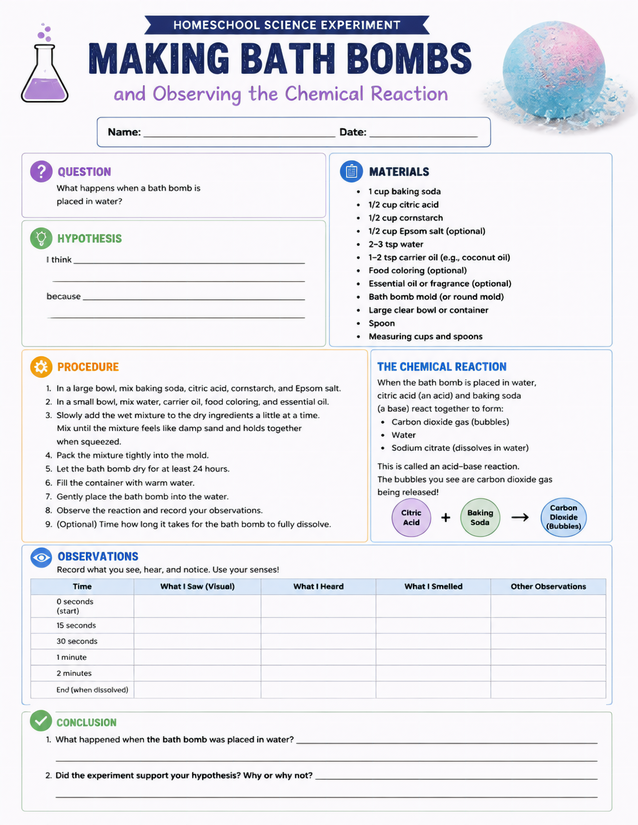
Citric acid meets baking soda in this making bath bombs lab sheet for grades 3-6 homeschoolers. All materials are household staples.
Getting Started with Your Making Bath Bombs Lab Sheet

Usage Notes
Nearly every item on the materials list is already in most home kitchens: baking soda, cornstarch, and measuring cups are standard pantry staples. Citric acid and a bath bomb mold are the only specialty supplies, both widely available and inexpensive. Carrier oil and food coloring are listed as optional, so the experiment works even with the bare minimum ingredients.

Printing Tips
A 24-pound paper weight gives students enough surface to write comfortably in the timed observation table without ink bleed-through. Print as a loose sheet on a clipboard so your student can record at the lab bench while the bath bomb dissolves, or three-hole punch it to slide into a homeschool science lab notebook after the experiment is complete.