Creative Minds 𖹭 Happy Hearts

Making Homemade Cheese Science Lab Sheet, Protein Denaturation
Milk transforms into curds before your student’s eyes, and this making homemade cheese science lab captures every stage of that protein chemistry in writing.
Casein protein denaturation is the science hiding inside your kitchen, and this lab sheet brings it into clear focus for grades 4 through 7. Your student records the appearance of the milk before acid is added, describes what happens when the curds separate from the whey, notes the temperature at which the milk was removed from heat, and then answers four analysis questions connecting the process to everyday foods like yogurt and scrambled eggs. The making homemade cheese science lab guides students through a nine-step procedure using one gallon of whole milk, white vinegar or lemon juice, salt, a large pot, cheesecloth, and a colander, with a heat-safe thermometer listed as optional.
This sheet works beautifully as a standalone kitchen science session or as an anchor lab inside a unit study on food chemistry, biology of proteins, or states of matter. A built-in vocabulary panel defines protein, denaturation, coagulation, curd, and whey, so your homeschooler builds scientific language alongside the hands-on process. The homeschool tip printed at the bottom even suggests varying the acid source or adding herbs, which opens the door to a controlled variable experiment your student can design independently.
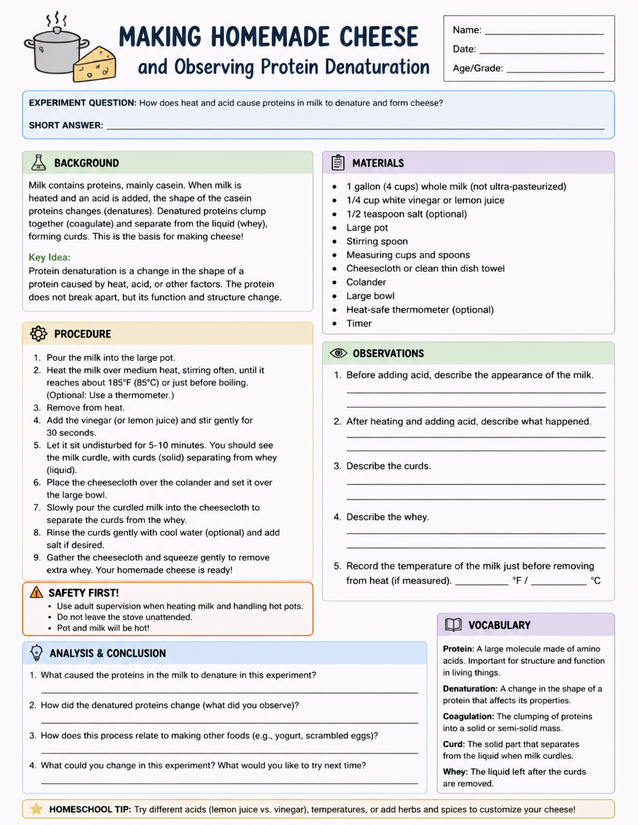
Grades 4-7 homeschoolers explore making homemade cheese science lab style, observing casein protein denaturation with milk, vinegar, and heat.
Getting Started with Your Making Homemade Cheese Science Lab

Usage Notes
Every material on this sheet is a household staple: whole milk (not ultra-pasteurized), white vinegar or lemon juice, salt, a large pot, cheesecloth or a thin dish towel, a colander, and a large bowl. No specialty supplies are needed, though a heat-safe thermometer is listed as optional for precise temperature recording. The sheet includes a clearly marked Safety First section reminding parents to supervise all stovetop heating, keep students away from the unattended burner, and account for a hot pot and hot liquid throughout the process.

Printing Tips
A single copy on 24-pound paper gives students enough surface to write full observation descriptions without ink bleeding through. Slip it into a clear page protector inside a science lab notebook so the procedure stays visible while your student works at the stove, then remove it to fill in observations once the pot is off the heat.