Creative Minds 𖹭 Happy Hearts

Making Homemade Perfume with Flowers and Alcohol
Crushed rose petals steeped in rubbing alcohol for seven days produce a scent your student formulated themselves. Making homemade perfume with flowers turns essential oil chemistry into something they can wear.
This lab sheet walks your student through the chemistry of fragrant compounds called essential oils and how alcohol acts as a solvent to extract them from flower petals. The sheet covers a full eight-step procedure including preparing the flowers, filling and sealing the jar, steeping for three to seven days, straining through cheesecloth or a coffee filter, and bottling the finished liquid. Observation prompts ask students to note the color of the liquid, describe the scent, and track how the fragrance changes over the steeping period. It suits grades 4 through 7 and pairs naturally with a unit study on plant biology, chemistry of mixtures, or the senses.
Making homemade perfume with flowers fits well as a multi-day investigation because the steeping window gives your student a built-in reason to return, observe, and record changes daily. The results and conclusion section asks what worked well, what they would change, and what they learned, giving your homeschooler practice drawing evidence-based conclusions. The sheet works as a standalone experiment or as an extension within a botany or chemistry unit, and the labeled bottle your student produces at the end is a concrete, tangible result of the scientific process.
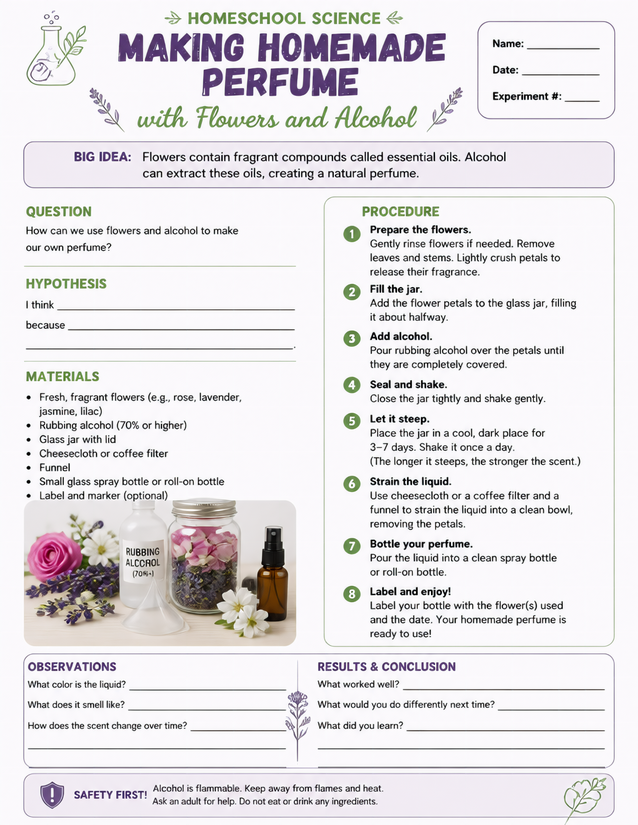
Flower petals and rubbing alcohol combine in this making homemade perfume with flowers lab sheet for grades 4 through 7.
Investigating Making Homemade Perfume with Flowers

Usage Notes
Fresh fragrant flowers such as rose, lavender, jasmine, or lilac are the only specialty gather here. Everything else, including the glass jar with a lid, cheesecloth or a coffee filter, a funnel, and a small spray or roll-on bottle, is likely already in the house or easy to source. The sheet carries a prominent Safety First note: rubbing alcohol at 70 percent or higher is flammable, so this experiment should be done away from any open flame or heat source, and an adult should be present throughout.
Printing Tips
A sheet destined to sit on the counter for up to a week of daily observations holds up better on 32-pound paper than on standard copy stock. Slip it into a plastic page protector if your student is recording daily beside a jar, or punch and bind it directly into a science lab notebook at the start of the experiment.