Creative Minds 𖹭 Happy Hearts

Making Homemade Yogurt Lab Sheet, Bacterial Fermentation
Warm milk and a spoonful of yogurt starter kick off one of the most edible experiments in homeschool science. This making homemade yogurt lab sheet walks your student from 180°F all the way to a finished, tangy result.
Bacterial fermentation is the science, but the payoff is real food your student made themselves. Designed for grades 4-7, this making homemade yogurt lab sheet opens with background on Lactobacillus bulgaricus and Streptococcus thermophilus, then guides students through heating milk, cooling it, adding a live-culture starter, incubating for 6-12 hours, and chilling. A timed observation table prompts students to record appearance, smell, and texture or taste at the start, 2, 4, 6, 8, and 10-12 hour marks, building a real dataset across the fermentation window.
Five Think and Explain questions ask students to connect observations to mechanism, including why warmth matters for incubation, what counts as evidence that fermentation occurred, and how refrigeration stops the process. A conclusion section requires written synthesis, and three extension ideas push further inquiry into milk type variables and using homemade yogurt as the next batch’s starter. As a standalone kitchen lab or an anchor activity in a microbiology or food science unit study, this sheet asks students to demonstrate observation, hypothesis reasoning, and scientific communication together.
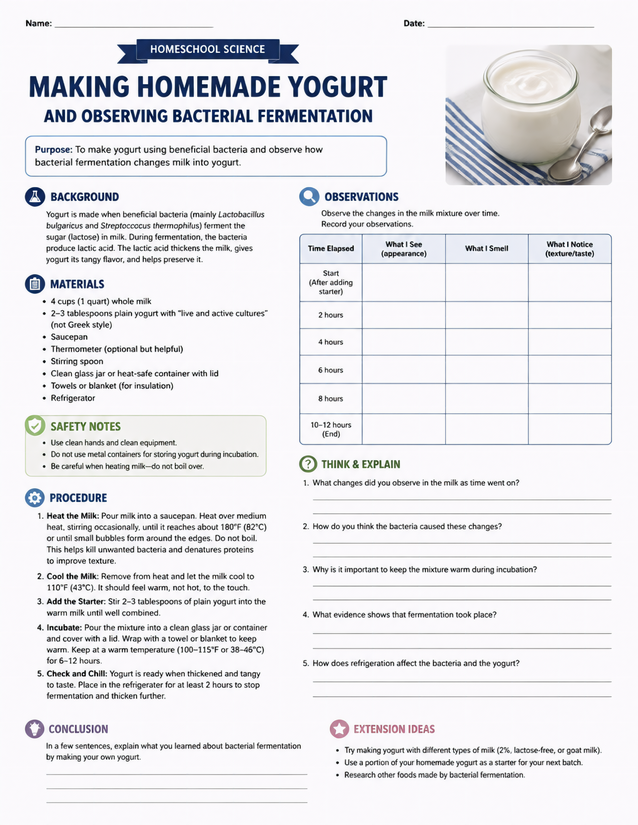
Warm milk, a yogurt starter, and six to twelve hours reveal bacterial fermentation in action. Making homemade yogurt lab sheet suits grades 4-7.
Investigating with Your Making Homemade Yogurt Lab Sheet

Usage Notes
Nearly every item on the materials list is already in a home kitchen: whole milk, plain yogurt with live cultures, a saucepan, stirring spoon, and a glass jar or heat-safe container with a lid. Towels or a blanket for insulation and a refrigerator complete the setup. The safety notes on the sheet specifically flag avoiding metal containers during incubation, using clean hands and equipment, and not boiling the milk when heating.

Printing Tips
A loose sheet on a clipboard works well here since students return to the observation table every two hours across a long incubation window. Twenty-pound copy paper is fine for pencil entries, but if you want to insert it into a lab notebook afterward, print at home and fold it in.