Creative Minds 𖹭 Happy Hearts

Making Paper from Recycled Materials, Step-by-Step Lab Sheet
Soaked newspaper, a blender, and a screen are all it takes. Making paper from recycled materials turns a handful of household items into a hands-on lesson your student will actually remember.
Structured around a clear scientific method, this lab sheet guides grades 3-6 students through turning used paper into new paper by breaking it down into pulp, forming a sheet on a screen or frame, and letting it dry. Students record a hypothesis, describe what happened in the observations section, draw the paper or the steps they saw, then answer three reflection questions: whether their hypothesis held up, what they learned, and how they might improve the paper next time.
Making paper from recycled materials fits naturally into an earth science or environmental unit study focused on recycling, sustainability, or material cycles. It works as a standalone hands-on experiment or as a companion to lessons on natural resources and waste reduction. Completing the sheet demonstrates a student’s ability to follow a multi-step procedure, observe a physical transformation, and connect a real-world process to scientific thinking.
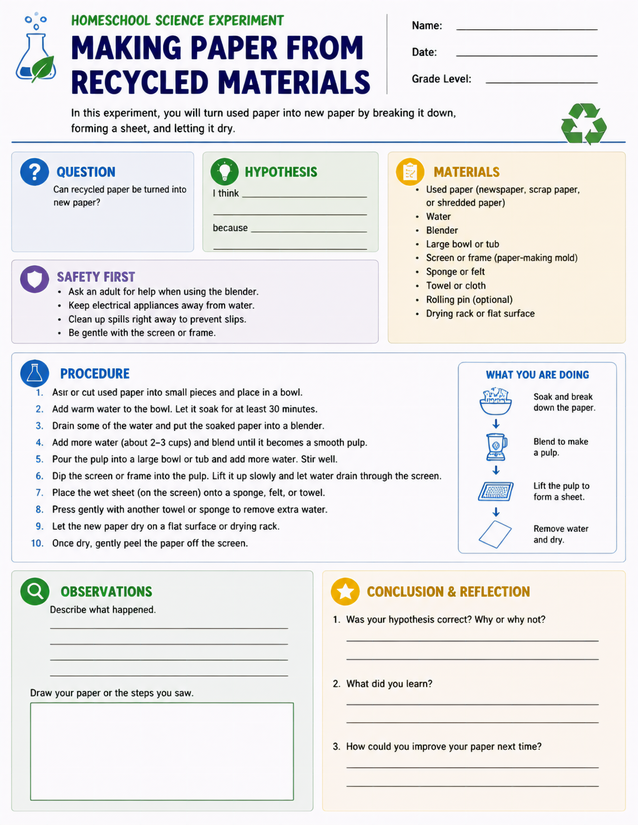
Used newspaper becomes new paper in this making paper from recycled materials homeschool experiment for grades 3-6. All household supplies.
Investigating Making Paper from Recycled Materials Step by Step

Usage Notes
Every material on this sheet is a household item: used newspaper or scrap paper, water, a blender, a large bowl, a sponge or felt, and a towel. The one specialty item is a screen or paper-making frame, which can be substituted with a piece of fine mesh stretched over a wooden frame. The safety section flags blender use specifically, so adult supervision is required for steps three and four.
Printing Tips
Standard copy paper works for a one-time lab, but 24 lb paper holds up better if students press firmly in the observations section. Slide the finished sheet into a lab notebook or a plastic page protector to keep it alongside any samples of the paper your student actually made.