Creative Minds 𖹭 Happy Hearts

Making Vinegar from Apple Cider, Wild Yeast Fermentation Lab
Wild yeast already lives on apple skins and in the air around your kitchen. Making vinegar from apple cider puts that invisible biology to work over three to eight weeks of real, observable fermentation.
This lab walks your student through a genuine two-phase fermentation process: Phase 1 converts the natural sugars in unpasteurized apple cider into alcohol using wild yeast over three to seven days, and Phase 2 introduces acetic acid bacteria to transform that alcohol into vinegar over two to six weeks or more. The recording sheet includes a daily observations table with columns for date, appearance, smell, taste, and optional pH, plus conclusion prompts asking what happened in each phase and what your student would try next. Suited for grades 5 through 8, it pairs well with a microbiology or chemistry unit and gives your homeschooler a direct look at how microorganisms drive chemical change.
Making vinegar from apple cider works as a standalone long-term project or as the anchor experiment in a broader fermentation unit study. Because the process unfolds over weeks, your student practices sustained scientific observation rather than a single-session result, which is a skill worth building deliberately. Completing the sheet demonstrates understanding of alcoholic fermentation, acetic acid fermentation, the role of wild microorganisms, and basic food chemistry.
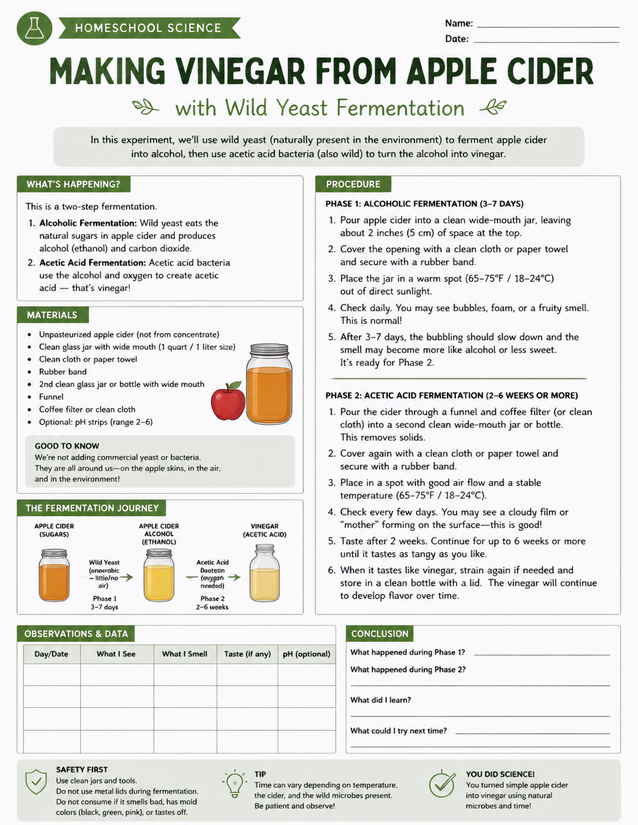
A two-phase making vinegar from apple cider experiment for grades 5-8, using wild yeast and acetic acid bacteria. All household materials.
Investigating Making Vinegar from Apple Cider in Two Phases

Usage Notes
Every material on the list is a household item: unpasteurized apple cider, wide-mouth glass jars, clean cloth or paper towels, rubber bands, a funnel, and optional coffee filters. No commercial yeast or bacterial cultures are needed because wild microbes do the work. The sheet notes not to use metal lids during fermentation and to discard the batch if mold appears in black, green, or pink.

Printing Tips
Twenty-four-pound paper gives the observations table enough body to handle repeated daily entries with a pen or pencil over several weeks. Keep the sheet loose in a clipboard near your fermentation jars so your student can record without moving the experiment, or slide it into a dedicated lab notebook section marked for long-running projects.