Creative Minds 𖹭 Happy Hearts

Testing Which Metals Are Most Resistant to Corrosion, Five-Metal Comparison
Five metals, one salt-and-vinegar solution, five days of watching: this metals most resistant to corrosion lab gives your student a front-row seat to real electrochemical change.
Your student tests five common metals, steel (iron) nail, copper penny, aluminum foil, brass screw, and stainless steel paper clip, by submerging each in white vinegar mixed with table salt and recording daily corrosion ratings over five days. The data table uses a 0-to-3 scale (no change through heavy corrosion), so results are easy to compare and graph. Designed for grades 4 to 6, this homeschool worksheet builds vocabulary around oxidation and corrosion while reinforcing disciplined daily observation.
This lab fits naturally into a chemistry or materials science unit study, and it works as a standalone investigation with no prep beyond gathering household items. By the end of day five, your homeschooler draws a conclusion about which metals most resistant to corrosion held up best and explains why some corroded faster than others. The think-further prompt asking how corrosion is prevented in everyday life adds a real-world engineering connection that extends the lesson without extra prep.
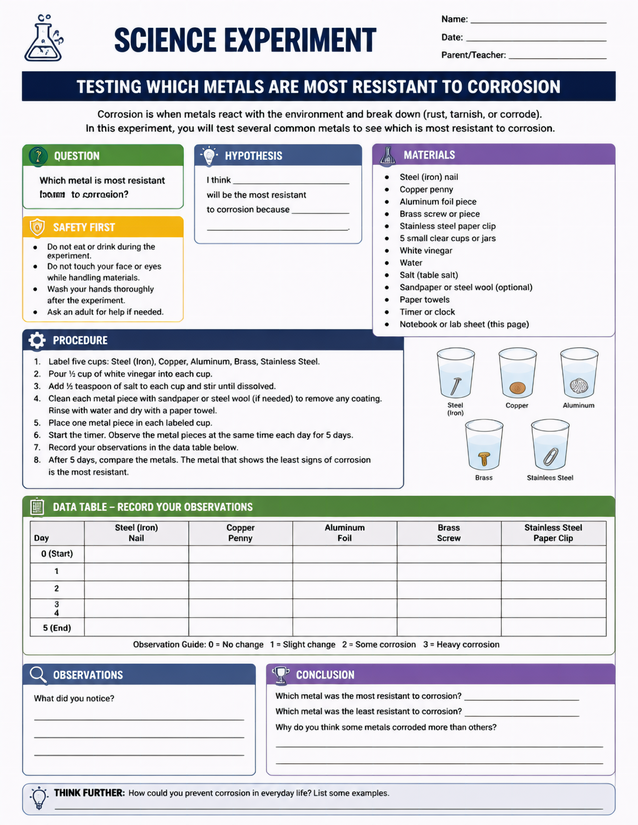
Find out which metals most resistant to corrosion survive five days in vinegar and salt. Grades 4-6 homeschool science experiment.
Investigating Metals Most Resistant to Corrosion Over Five Days

Usage Notes
Nearly everything on the materials list is already in your kitchen: white vinegar, table salt, paper towels, and five small clear cups or jars. The five metal pieces (steel nail, copper penny, aluminum foil, brass screw, stainless steel paper clip) are low-cost and easy to source. Sandpaper or steel wool is listed as optional for removing coatings before the test, and the safety section reminds students not to eat or drink during the experiment and to wash hands thoroughly afterward.

Printing Tips
A 24 lb or heavier sheet keeps the data table from buckling under repeated pencil entries across five days. Slip the sheet into a page protector inside a lab notebook so it stays flat on the counter while your student checks the cups each morning.