Creative Minds 𖹭 Happy Hearts

Miniature Erupting Volcano Lab Sheet, Geological Layers
Baking soda meets vinegar inside a clay-layered volcano your student built from scratch. The miniature erupting volcano lab sheet walks through both construction and the chemical reaction, step by step.
This miniature erupting volcano lab sheet guides your student through two distinct phases: building a layered clay model inside a clear cup and then triggering a foamy eruption with a baking soda and vinegar reaction. A labeled cross-section diagram identifies the crater, vent, lava layers, ash layers, base rock, and magma chamber, giving your homeschooler concrete vocabulary to anchor what they observe. The sheet suits grades 4-7 and connects geology to basic chemistry in one hands-on session.
Four reflection questions at the bottom ask students to describe the eruption, compare layer strength, draw parallels to a real volcano, and record lingering questions, making this a strong standalone lab or a natural anchor for an earth science unit study. Completing it demonstrates understanding of volcanic structure, the acid-base reaction producing carbon dioxide, and the difference between a model and the real geological process. The vocabulary panel covering volcano, magma, lava, eruption, and vent supports Charlotte Mason-style narration after the experiment.
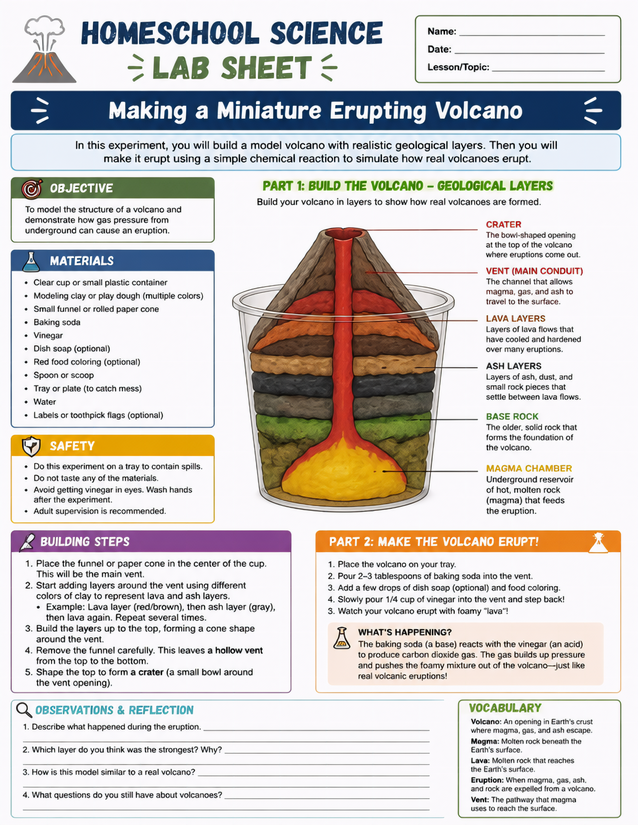
Build and erupt a miniature erupting volcano lab sheet for grades 4-7, using baking soda, vinegar, and modeling clay.
Investigating the Miniature Erupting Volcano Lab Sheet

Usage Notes
Nearly all materials here are household staples: a clear cup or small plastic container, modeling clay or play dough in multiple colors, baking soda, vinegar, and a tray. A small funnel or rolled paper cone forms the vent. Dish soap and red food coloring are listed as optional additions. Vinegar is a mild acid, so the sheet recommends adult supervision and keeping it away from eyes.

Printing Tips
A single sheet on 24 lb paper holds up well against the occasional vinegar splash better than standard copy weight. Print one per student, keep it loose on a clipboard beside the build tray, and have your homeschooler fill in observations while the eruption is still fresh rather than transcribing from memory later.