Creative Minds 𖹭 Happy Hearts

Making a Model of Continental Drift with Moving Clay Sections
Pangaea reassembled on a baking sheet: your student builds a model of continental drift with clay and actually pushes the plates apart with their hands.
This lab sheet walks grades 4-7 homeschoolers through a seven-step process for modeling how Earth’s tectonic plates carry continents across the asthenosphere over millions of years. Students flatten a clay base layer representing the asthenosphere, cut out plate-shaped pieces in a second color, add smaller continent shapes on top, mark positions with a marker, then physically push the plates in different directions and record what happens. The observation section asks them to sketch or describe the before and after positions, and three reflection questions prompt deeper thinking about how the model compares to real geological movement.
This model of continental drift with clay fits naturally into a plate tectonics unit study and works especially well following a lesson on Pangaea, since the sheet opens with a brief explanation of the supercontinent concept. Completing it gives your student a concrete demonstration of how colliding, separating, and sliding plates produce the continental arrangement we see on maps today, connecting abstract geological timescales to something they can observe in a single session.
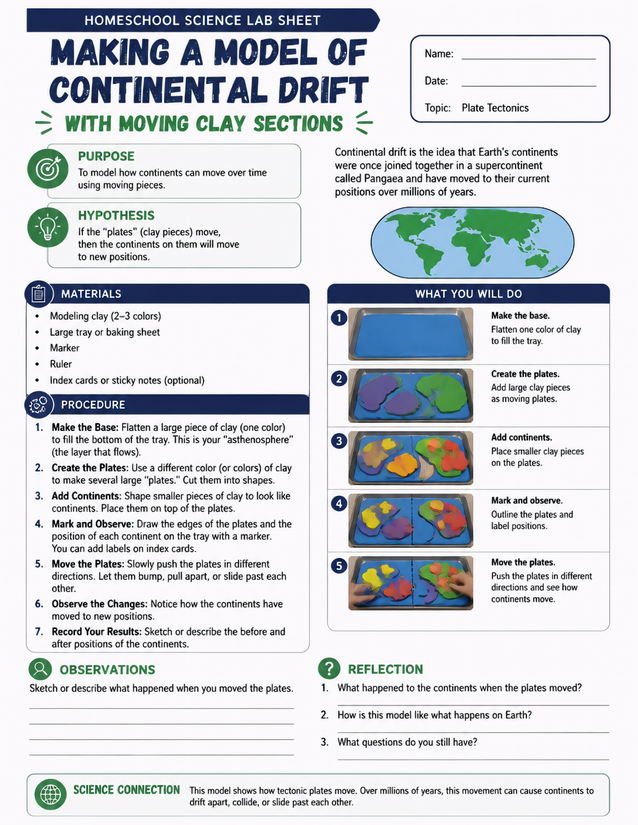
Hands-on model of continental drift with clay sections teaches plate tectonics for grades 4-7 homeschoolers. Includes hypothesis, observations, and reflection.
Exploring a Model of Continental Drift with Clay

Usage Notes
Modeling clay in two or three colors is the main supply, and the sheet specifies a large tray or baking sheet as the base. A marker and ruler round out the list, with index cards or sticky notes listed as optional for labeling plate positions. Everything here is a household or easily sourced craft item, and no heat or chemicals are involved, so there are no safety concerns beyond keeping the clay off upholstery.

Printing Tips
Standard 24 lb paper handles pencil and marker well enough for the observation sketch and reflection answers. Slip the sheet into a plastic page protector inside a lab notebook so students can reference the procedure steps while their hands are clay-covered.