Creative Minds 𖹭 Happy Hearts

Making a Model of Plate Tectonics with Graham Crackers
Frosting doubles as magma and graham crackers stand in for Earth’s crust in this model of plate tectonics with graham crackers that makes abstract geology genuinely tangible.
Your student models all three tectonic boundary types on a single paper plate using graham crackers and frosting or peanut butter as a stand-in for magma. The sheet walks through divergent, convergent, and transform boundaries in sequence, with photographs of each cracker configuration, real-world examples like the Mid-Ocean Ridge, Andes Mountains, and San Andreas Fault, and a labeled observations section where students record what happened at each boundary. A vocabulary panel defines six terms including tectonic plate, magma, and crust. Discussion questions ask students to reason about which boundary type creates new crust and how plate movement changes Earth’s surface over time. This model of plate tectonics with graham crackers fits grades 4-7 and pairs well with an earth science or geology unit study.
The lab works as a standalone lesson or as an anchor activity before introducing plate boundary diagrams in a textbook sequence. Completing all three models and the observations section demonstrates that your student can distinguish between boundary types, connect physical movement to geological outcomes, and use earth science vocabulary accurately in writing. The Think and Discuss questions push toward higher-order reasoning without requiring additional reading, making this a strong Charlotte Mason-style narration alternative for hands-on learners.
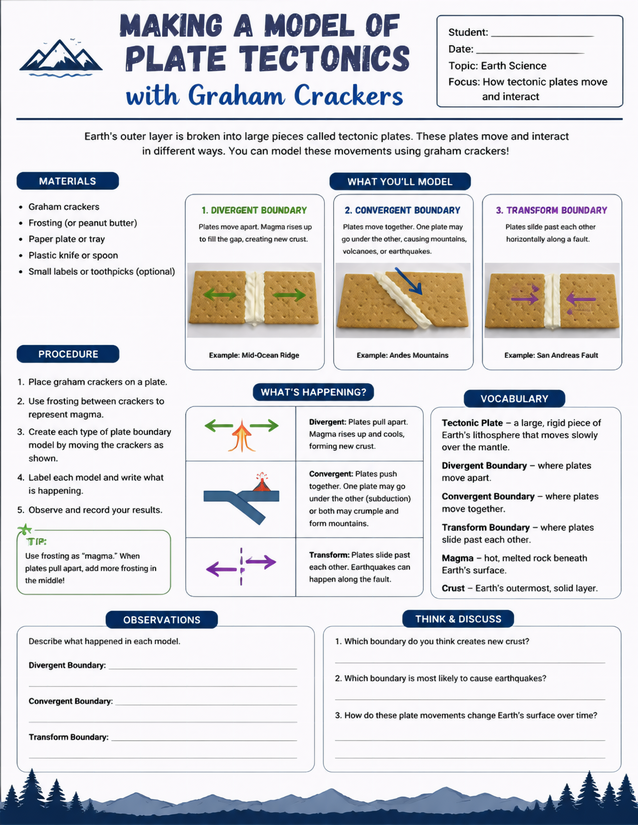
Graham crackers become tectonic plates in this hands-on model of plate tectonics with graham crackers, suited for grades 4-7 homeschoolers.
Investigating the Model of Plate Tectonics with Graham Crackers

Usage Notes
Graham crackers, frosting or peanut butter, a paper plate or tray, and a plastic knife or spoon are all the materials your student needs, and every item is a standard pantry staple. Small labels or toothpicks are listed as optional for identifying each boundary model. No heat or chemicals are involved, though the tip on the sheet reminds students to add frosting as magma when plates pull apart, so having a little extra frosting on hand is worth planning for.
Printing Tips
A single sheet on 24 lb copy paper holds up well enough for a one-session lab, but 32 lb paper survives better if hands are frosting-sticky during the observation-writing stage. Loose on a clipboard keeps it accessible while crackers are being arranged on a separate plate, and the sheet is detailed enough that laminating is not practical here since students write observations directly on it.