Creative Minds 𖹭 Happy Hearts

Making a Model of the Eye and Testing Depth Perception
Plastic cups, convex lenses, and a bead on a table reveal exactly why two eyes outperform one. This model of the eye and testing depth perception lab makes binocular vision something your student can feel, not just read about.
Your student builds a wearable eye model from clear plastic cups and small convex lenses, then immediately puts it to work in a structured depth perception test. The sheet walks through taping lenses into position at the base of each cup where the pupil would sit, using clay or playdough to hold the lens steady, and decorating the cups before wearing them as goggles. From there, the testing section has students line up a finger with a small object using one eye covered, then both eyes open, recording what changes each time. Designed for grades 4-7, this model of the eye and testing depth perception experiment connects directly to how the brain merges two slightly different images into a single sense of distance and depth.
The lab fits naturally into a human body unit study or a senses and perception sequence. Three follow-up questions push students to apply what they observed, asking why two eyes help the brain judge distance, which everyday activities depend on good depth perception, and how depth perception works in their own lives. A challenge section extends the experiment by having students try navigating with one eye patched, and an extension prompt sends them to research how other animals perceive depth. Completing the full sheet, from building the model to answering the think-and-apply questions, demonstrates both procedural science skills and the ability to connect a physical model to a biological concept.
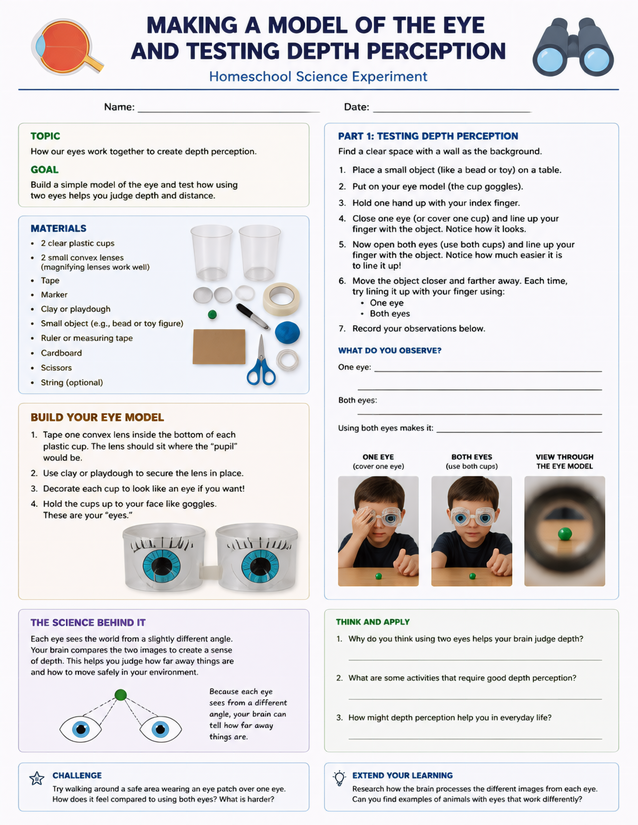
Build a model of the eye and testing depth perception becomes hands-on with this homeschool science lab sheet for grades 4-7.
Recording Results for the Model of the Eye and Testing Depth Perception

Usage Notes
Household supplies cover most of the build: clear plastic cups, tape, a marker, clay or playdough, scissors, cardboard, and a small object like a bead or toy figure. The two small convex lenses are the one specialty item, though the sheet notes that magnifying lenses work well as a substitute. No heat or chemicals are involved, making this appropriate for independent student work with minimal supervision.
Printing Tips
Standard 20-24 lb copy paper handles all the writing sections without issue. Slip the sheet into a plastic page protector inside a science lab notebook, or keep it loose on a clipboard so your student can move around during the depth perception testing steps without worrying about the sheet.