Creative Minds 𖹭 Happy Hearts

Making a Model of the Food Chain in a Specific Biome
Pick a biome, build the chain, and show exactly where energy goes. This model of the food chain in a specific biome turns ecosystem concepts into something your student can hold and explain.
Your student selects one of six biomes, including forest, desert, grassland, tundra, ocean, or wetland, and then maps a food chain with a producer and at least three consumer levels. A planning table asks them to name each organism, its role, and what it eats, then draw arrows to show energy flow. An example forest model featuring grass, grasshopper, frog, snake, and hawk gives a concrete visual before they design their own. This lab sheet is well matched to grades 4-6 and fits naturally into a life science or ecology unit.
As a hands-on learning activity, making a model of the food chain in a specific biome moves beyond worksheet recall and into physical construction. Part 2 guides your student through assembling organisms in order inside a box or tray, labeling each with its role, and adding energy-flow arrows. Part 3 closes with three reflection questions, including what happens when one organism disappears, so your student demonstrates understanding of interdependence, not just sequencing. An optional challenge asks them to add a decomposer and explain its role, which extends the activity for advanced homeschoolers.
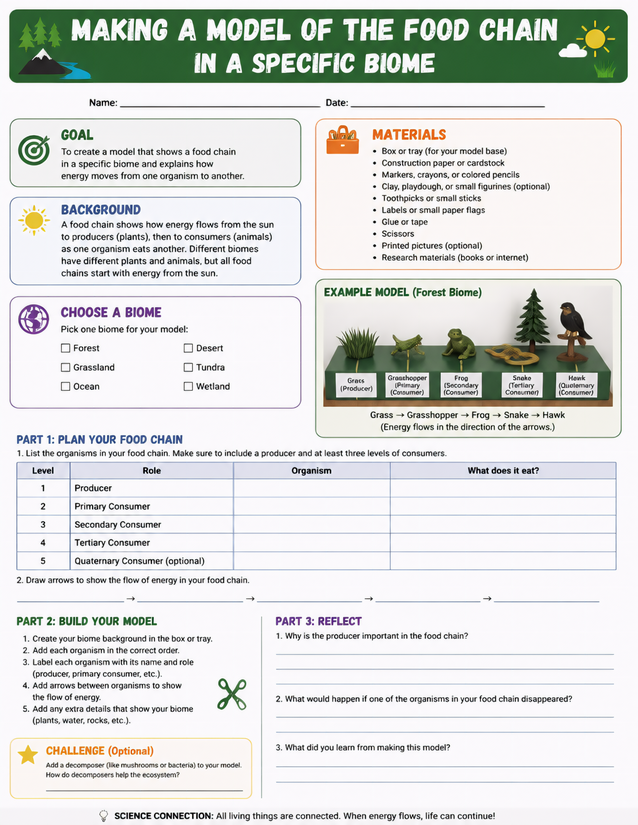
Choose a biome, plan your food chain, and build a physical model. This lab sheet suits grades 4-6 homeschoolers studying ecosystems.
Investigating a Model of the Food Chain in a Specific Biome

Usage Notes
Most materials on this sheet are household staples: a box or tray for the base, construction paper, markers, glue, and scissors. Clay, playdough, or small figurines are listed as optional for representing organisms three-dimensionally. No specialty supplies are required, though printed pictures or research materials are suggested for reference during the build.
Printing Tips
Cardstock at 65 lb holds up better than copy paper when the sheet sits next to a glue-and-clay build station. Print one copy per student, punch the left margin, and file it in a science binder after the model is photographed and the reflection questions are complete.