Creative Minds 𖹭 Happy Hearts

Making a Model of the Immune Response to a Virus
Red pom-poms, purple clay, and yellow pipe cleaners turn an invisible biological process into something your student can point to and explain. Building a model of the immune response makes white blood cells, antibodies, and memory cells concrete.
Your student constructs a four-step physical model showing how the body detects, fights, and remembers a virus. Using cardboard as the body, they place red pom-poms for viruses, purple clay for white blood cells, green beads for immune cells, yellow pipe cleaners for antibodies, and blue clay for memory cells, then draw arrows connecting each stage. The sheet includes a background section, a guiding question, labeled procedure steps, and an observations box, making it a complete record of the model of the immune response for grades 4 to 7.
This lab fits naturally into a human biology unit study on body systems, and it works as a standalone lesson on immunity without requiring prior lab experience. A challenge prompt at the bottom asks your student to research a specific virus like influenza or COVID-19 and add one new detail to the model, extending the activity for older or advanced learners. Completing the Think and Reflect questions requires your student to explain why immunological memory matters and how model limitations apply to real biology.
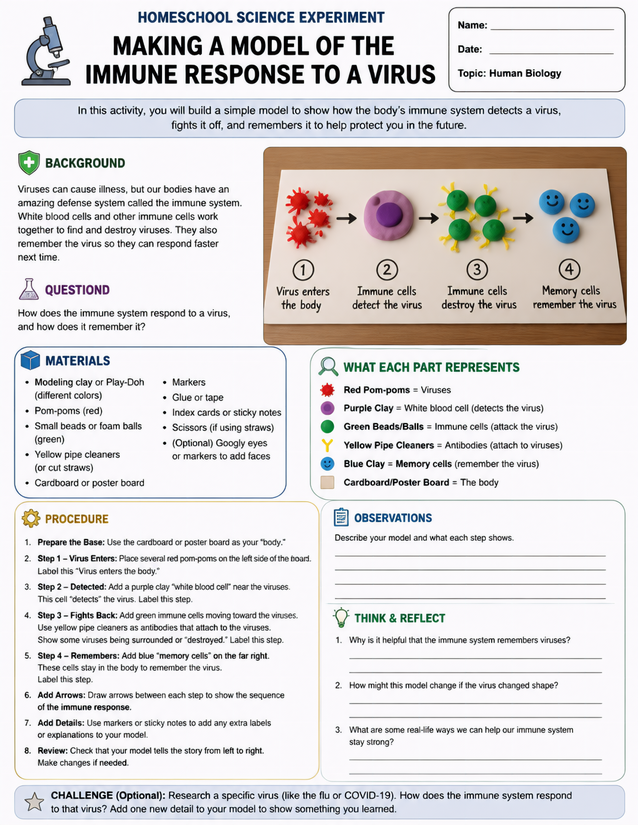
Grades 4-7 homeschoolers build a hands-on model of the immune response using clay, pom-poms, and pipe cleaners. Instant download.
Investigating a Model of the Immune Response with Clay and Pom-Poms

Usage Notes
Nearly everything on the materials list is a household or craft supply: cardboard or poster board, modeling clay or Play-Doh in multiple colors, pom-poms, small beads or foam balls, pipe cleaners, markers, and glue. No specialty science supplies are required, which makes setup straightforward. Scissors are listed for cutting straws if used as structural elements, so supervise younger students during that step.

Printing Tips
Cardstock at 65 lb gives the sheet enough body to write on while your student is actively building the model nearby. Loose on a clipboard works well here since the procedure and observation sections are used side by side with the physical model on a flat surface.