Creative Minds 𖹭 Happy Hearts

Making a Model of the Immune System’s Memory Cells
Red pom-poms are germs, blue pom-poms are immune cells, and five plastic cups tell the whole story of how your body remembers a threat. This model of the immune system’s memory cells makes immunology tangible for grades 4-7.
Your student moves pom-poms between cups to act out what happens during a first exposure to a germ, the immune response that fights it off, and what remains in the body afterward as a memory cell. The sheet walks through all five stages with labeled procedures and closes with three Think and Reflect questions asking students to explain why memory cells matter, what would happen without them, and to connect the concept to a real-life example such as vaccines. This model of the immune system’s memory cells is well-suited for grades 4-7 and pairs naturally with a unit on human body systems or disease and immunity.
The lab stands on its own as a one-session activity, but it transitions cleanly into the Further Exploration prompt printed at the bottom, which asks students to research how vaccines create memory cells without causing illness. Completing the five-stage model demonstrates that your homeschooler understands acquired immunity as a process, not just a vocabulary word, and the reflection questions push toward applied reasoning rather than simple recall.
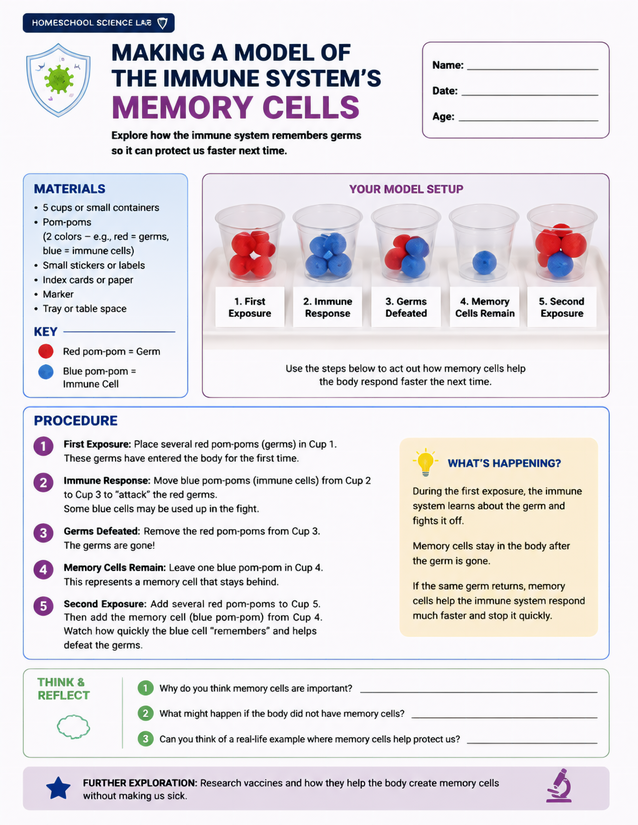
Red and blue pom-poms bring the model of the immune system’s memory cells to life for grades 4-7 homeschoolers. Download free.
Investigating a Model of the Immune System’s Memory Cells

Usage Notes
Pom-poms in two colors, five small cups or containers, index cards, a marker, and stickers or labels are all the materials listed. Everything on this sheet is a household or dollar-store supply, so no specialty ordering is required. No safety concerns apply, making this an easy setup even for younger students working independently.

Printing Tips
Standard copy paper holds up fine for this sheet since students write only short reflection answers rather than recording measurements. Slip it into a lab notebook after completing the cup activity, or keep it loose on the table as a reference while your student moves pom-poms through each stage.