Creative Minds 𖹭 Happy Hearts

Mosquito Repellent Effectiveness Lab Sheet, DEET vs. Natural
Two jars, three repellents, and fifteen minutes outdoors: the mosquito repellent effectiveness lab sheet turns a backyard nuisance into a controlled experiment your student can actually run.
Students use this mosquito repellent effectiveness lab sheet to compare DEET spray, a natural repellent, water, and an untreated control across four jar setups. The sheet walks them through labeling jars, preparing cotton pad surfaces, placing the jars outdoors where small insects are active, and counting insects after a fifteen-minute wait. A structured data table records insect counts for each condition, and the conclusion prompt asks students to identify the most effective repellent and explain their reasoning. This fits grades 4 to 7 and pairs well with a unit study on insects, chemical safety, or consumer science.
As a standalone lab, the mosquito repellent effectiveness lab sheet gives your homeschooler practice in controlling variables, since the sheet explicitly requires the same time, location, and jar type for every trial. It also introduces the concept of a control group in a concrete, memorable way. Students who complete it demonstrate the ability to design a fair test, collect numerical data, and draw an evidence-based conclusion rather than just guessing which product works.
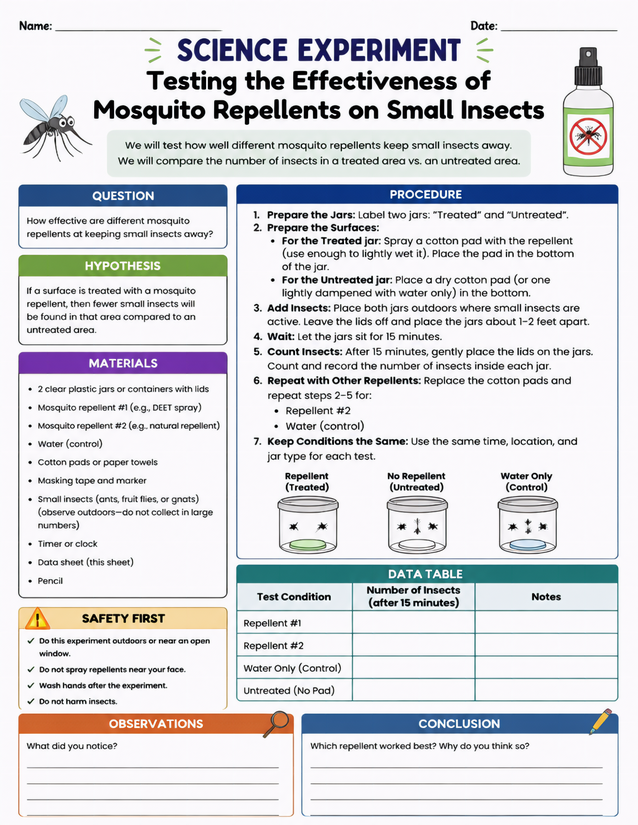
Compare DEET and natural sprays with this mosquito repellent effectiveness lab sheet, designed for grades 4-7 homeschoolers. Instant download.
Investigating the Mosquito Repellent Effectiveness Lab Sheet Outdoors

Usage Notes
Nearly everything on the materials list is already in most households: two clear plastic jars or containers with lids, cotton pads or paper towels, masking tape, a marker, and a timer. The one variable is the repellents themselves. One trial calls for a DEET-based spray and one for a natural repellent, so you will need to have both on hand before the experiment begins. The safety section on the sheet is worth reading aloud with your student before you start: spray the cotton pad, not the face, wash hands after, and observe insects outdoors without collecting them in large numbers.

Printing Tips
A 24-lb copy paper weight works fine here since students only write counts and short notes rather than doing extended writing during the experiment. Printing one copy per trial run is the cleanest approach, though the data table is compact enough that a single sheet covers all four conditions. Slip it into a clipboard for outdoor use so it stays flat while your student moves between jars.