Creative Minds 𖹭 Happy Hearts

Observing the Behavior of Moths Near Different Light Sources
Moth behavior near light sources is one of those questions kids already have, and this lab sheet turns that curiosity into a structured outdoor night experiment with real data.
Your student forms a hypothesis, sets up three different light sources at least three meters apart, and counts moths within a one-meter radius and on the screen behind each light across three timed trials. The data table tracks results for a white LED bulb, a yellow lamp, and a flashlight, with columns for moths around the light and moths on the screen, making it easy to spot patterns. This homeschool worksheet suits grades 4-7 and works well as a standalone unit study on animal behavior or phototaxis.
Completing the sheet asks your homeschooler to move beyond simple observation into comparison and analysis, answering questions about which light attracted the most moths, where moths spent more time, and what other variables might influence moth behavior near light sources. The analysis and conclusion sections build scientific reasoning skills that carry directly into biology and ecology units. It works as a single-session experiment repeated over several nights for stronger data.
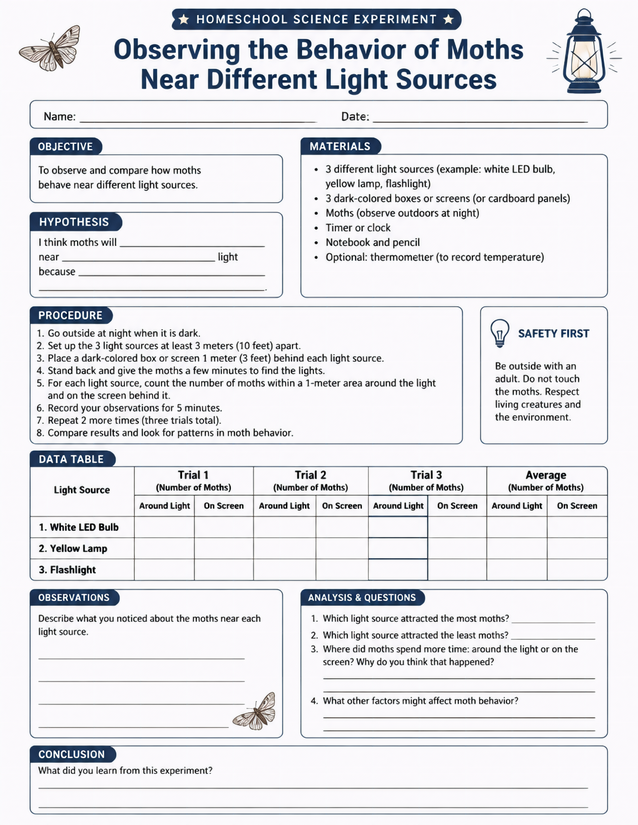
Compare moth behavior near light sources with this outdoor night experiment for grades 4-7 homeschoolers. Includes data table and analysis questions.
Getting Started with the Moth Behavior Near Light Sources Lab

Usage Notes
All materials on this sheet are household or easy-to-source items: three light sources such as an LED bulb, a yellow lamp, and a flashlight, plus dark-colored boxes or cardboard panels to serve as screens. A timer and notebook are the only other requirements. The sheet includes a Safety First note reminding students to go outside with an adult, avoid touching the moths, and respect living creatures.
Printing Tips
Standard 20 lb copy paper works fine clipped to a clipboard for outdoor use, though 24 lb paper holds up better if there is any evening dew. Slide the completed sheet into a lab notebook after the session, or laminate a blank copy and use dry-erase markers for the observation rows if you plan to repeat the experiment on multiple nights.