Creative Minds 𖹭 Happy Hearts

Multiplication Concept Introduction Worksheet, Equal Groups
Equal groups click faster when students can see them. This multiplication concept introduction worksheet builds that visual understanding before the memorization starts.
Laid out in two clear sections, this multiplication concept introduction worksheet opens with a labeled example box that walks students through three equal groups of four apples, showing both the repeated addition sentence and the multiplication sentence side by side. Section A then presents three visual problems where students write the multiplication sentence for sets of grouped stars, dots, and hearts already drawn on the page. This entry point suits grades 2 to 3 homeschoolers who are meeting multiplication for the first time.
Section B steps up the thinking: two word problems ask your student to draw their own equal groups and then write the matching multiplication sentence, one involving baskets of oranges and one involving rows of flowers. The shift from reading a visual to creating one builds genuine conceptual understanding rather than rote copying. It works well as a guided first lesson on multiplication, with you nearby to talk through the equal groups idea before your homeschooler completes Section B independently.
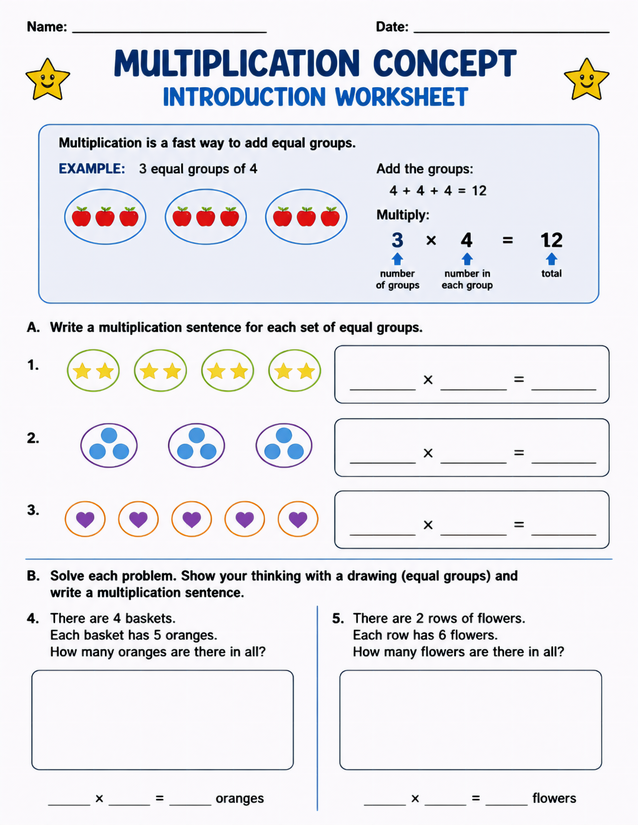
Equal groups, visual models, and word problems make this multiplication concept introduction worksheet ideal for grades 2-3 homeschoolers.
Getting Started with a Multiplication Concept Introduction Worksheet

Usage Notes
A pencil suits every part of this sheet, especially Section B where students sketch their own equal groups in the open drawing boxes. Section A is simple enough for independent practice once the example box has been discussed together. Section B works best as guided instruction the first time through, giving you a chance to ask questions as your student draws.

Printing Tips
Standard copy paper handles pencil drawing in Section B without any bleed. Portrait orientation is already set, and printing a small set of two or three copies lets students revisit the equal groups concept across multiple sessions as the idea firms up.