Creative Minds 𖹭 Happy Hearts

Music Tempo on Heart Rate Lab Sheet, Homeschool Science
Sit quietly, press two fingers to your wrist, and let the music tempo on heart rate experiment begin. Your student tests three tempos and records the numbers themselves.
Designed for grades 5-8, this music tempo on heart rate lab walks your student through a structured, self-contained experiment using only a music source, a timer, and a way to measure pulse. The sheet opens with a written hypothesis prompt, then guides students through eight numbered procedure steps: resting baseline measurement, five minutes of slow tempo listening, five minutes of medium, and five minutes of fast, with a rest period between each condition. The data table captures beats in 60 seconds, calculated heart rate in bpm, and a personal notes column for how the student felt during each condition.
This fits naturally into a human body unit study or a broader physics and sound exploration, and it pairs well with lessons on the autonomic nervous system or the science of stress and relaxation. Four analysis questions push beyond data recall into pattern recognition, asking which tempo produced the highest and lowest readings and how the student felt at each stage. The conclusion section asks your homeschooler to revisit their original hypothesis and interpret what the data actually shows, building the habit of evidence-based reasoning that carries across every science subject.
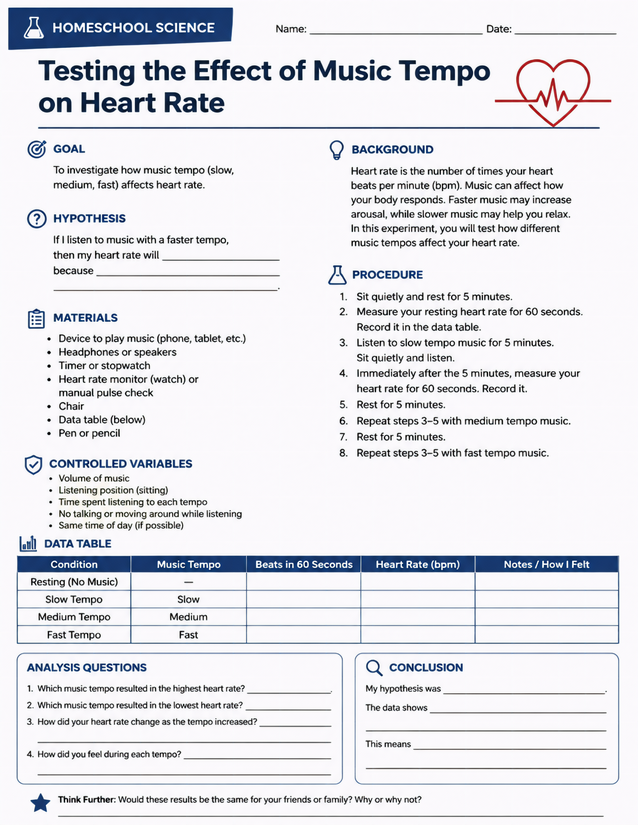
Grades 5-8 homeschoolers test how slow, medium, and fast music tempo on heart rate changes bpm. Includes hypothesis, data table, and conclusion.
Getting Started with the Music Tempo on Heart Rate Lab

Usage Notes
Almost everything on the materials list is already in your home: a phone or tablet, headphones or speakers, a timer, and a pen. The one variable is pulse measurement. The sheet lists a heart rate monitor watch as an option alongside a manual pulse check, so your student can complete this with or without any specialty equipment. No safety concerns are implied, though students should remain seated and calm throughout each listening condition to keep the controlled variables consistent.

Printing Tips
Standard 24-pound copy paper works well here since students write lightly during rest periods rather than in motion. Slip the sheet into a plastic page protector if you want to reuse the data table for a second trial comparing different music genres, and have your student record their numbers on a separate sheet inside.