Creative Minds 𖹭 Happy Hearts

Nested Square and Arrow Tile Coloring Page
Quilters and tessellation fans, meet your new obsession: the nested square and arrow tile coloring page brings that same satisfying block logic but entirely in ink.
Each tile in this pattern anchors around a diamond center, ringed by concentric square frames that step inward like a quilt block mid-construction. Arrow points shoot outward from every corner, interlocking with the neighboring tiles so cleanly that the grid reads as one continuous surface rather than individual units.
Look closely and you will find tiny standalone squares tucked into the joints between tiles, easy to miss on a first pass and genuinely rewarding to pick out with a contrasting color. This nested square and arrow tile coloring page sits in the intermediate range, busy enough to hold attention through a long session but structured enough that a simple three-color rotation will carry you from edge to edge. The part of the Geometric Designs collection, it has that quiet, rhythmic quality where you stop watching the clock.
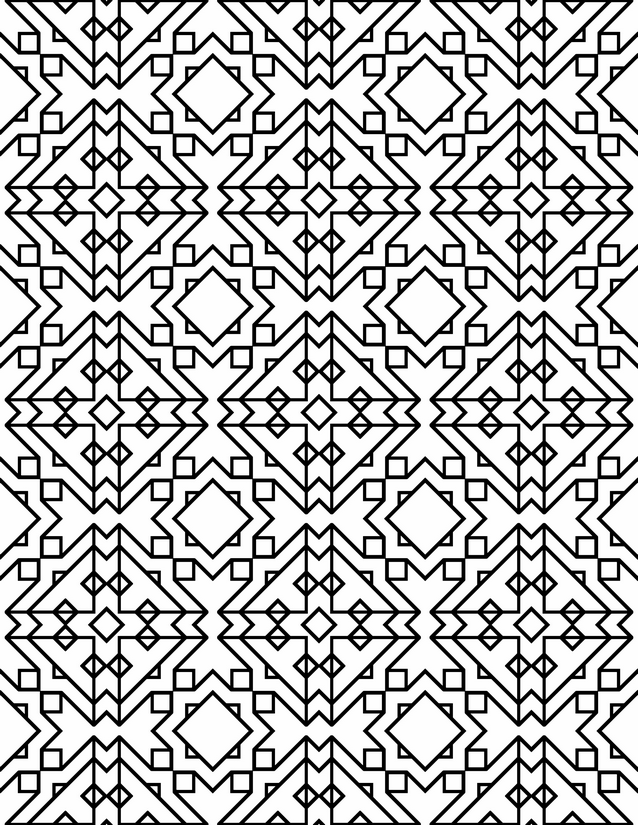
Concentric squares and sharp arrow points fill every tile in this nested square and arrow tile coloring page. Free instant download, print-ready.
Best Tools for the Nested Square and Arrow Tile Coloring Page

Usage Notes
Colored pencils are well suited here because the moderate line spacing gives you room to layer and burnish without crowding. Gel pens handle the small interior squares cleanly and add a satisfying pop if you want one zone to read as accent. Alcohol markers can fill the larger diamond centers quickly, but keep a light hand near the fine arrow-point lines because bleed can close off those narrow gaps.

Printing Tips
A 24 lb or heavier copy paper holds up better than standard 20 lb when you plan to layer colored pencil, since the repeated pressure can pill a thinner sheet. Keep your scale at 100 percent so the tile proportions stay true and the smallest squares do not shrink to the point of being hard to fill.