Creative Minds 𖹭 Happy Hearts

Non-Newtonian Fluids with Cornstarch Lab Sheet
Squeeze it slowly and it flows. Jab it fast and it locks up solid. Non-Newtonian fluids with cornstarch turn a mixing bowl into one of the most memorable science demos your homeschooler will ever do.
Your student mixes 1.5 cups of cornstarch with 1 cup of water, then works through seven activities that test how the oobleck responds to slow versus fast force. The observations table has a row for each activity, from pressing a finger in slowly to dropping an object from two different heights, and four analysis questions ask your student to explain the behavior in their own words and connect it to real-world uses like body armor and shoe soles. This non-Newtonian fluids with cornstarch lab sheet is well-matched for grades 4-7 and sits comfortably in a physics or matter unit.
The sheet works as a standalone lesson or as part of a broader states-of-matter unit study. An optional challenge asks your student to research another non-Newtonian fluid such as ketchup or quicksand and compare it to the cornstarch mixture, adding a research and writing component if you want to extend the session. Completing the lab demonstrates that your homeschooler can connect applied force to observable material behavior and articulate a basic definition of a non-Newtonian fluid.
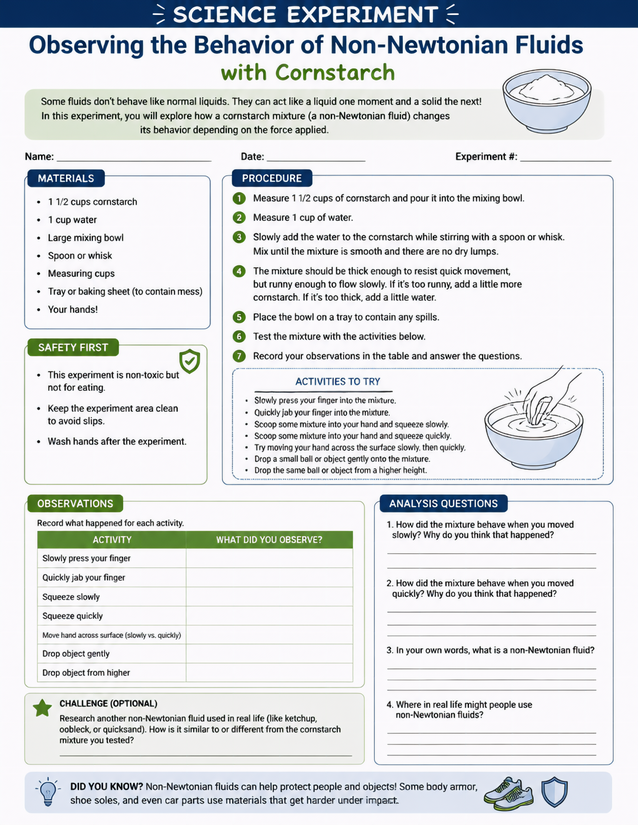
Hands-on non-Newtonian fluids with cornstarch experiment for grades 4-7, covering force, resistance, and real-world applications. Instant download.
Investigating Non-Newtonian Fluids with Cornstarch at Home

Usage Notes
Cornstarch and water are the only consumables, and both are standard pantry items. The sheet specifically lists a tray or baking sheet to contain the mess, which is worth taking seriously since oobleck splatter is a real outcome of the quick-jab activities. Hand-washing after the experiment is called out in the Safety First section, and the mixture is noted as non-toxic but not edible.
Printing Tips
Standard 20 lb copy paper is fine for the observations table, but a heavier 24 lb sheet holds up better if wet hands touch the page mid-experiment. Slip it into a clear plastic page protector and have your student record observations on the protector with a dry-erase marker for a fully reusable version.