Creative Minds 𖹭 Happy Hearts

Observing Bacteria in Pond Water Under a Microscope Lab Sheet
Pond water looks clear from a distance, but observing bacteria in pond water under a microscope reveals a world of shapes, movement, and color your student won’t forget.
Structured around a single guiding question, what do bacteria in pond water look like under a microscope, this lab sheet walks your homeschooler through collecting a sample, preparing a slide, and recording observations at low power (40x) and high power (400x). An optional methylene blue or iodine stain step adds contrast for easier viewing. The observations table asks students to note shape, movement, and color at each magnification level, making it a strong fit for grades 4 through 7 studying microbiology or life science.
The sheet works as a standalone lab or as part of a unit study on microorganisms, cell biology, or ecosystems. Four reflection questions at the bottom push your student past simple observation into reasoning about where bacteria live and why pond water hosts so many. Completing observing bacteria in pond water this way gives your homeschooler concrete practice with scientific recording, microscope technique, and biological drawing, all on one page.
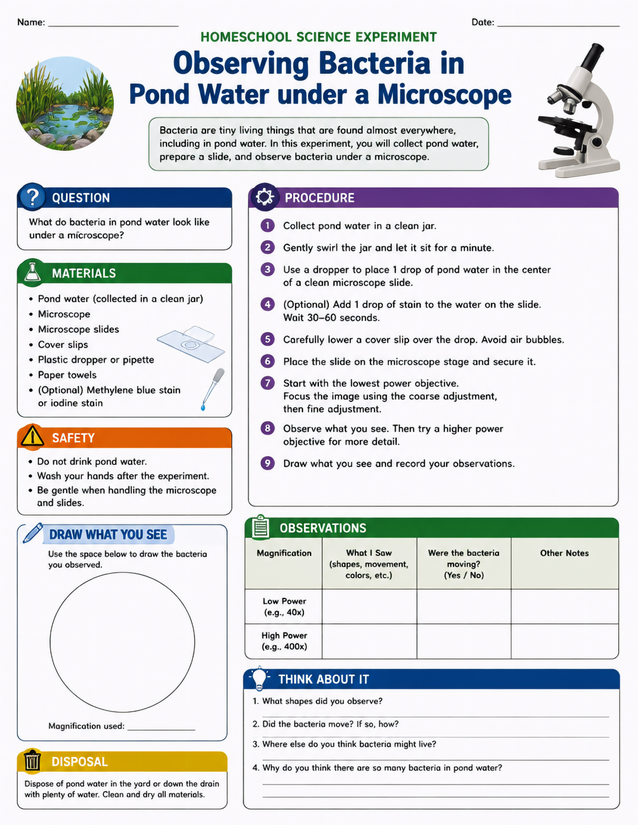
Collect a pond water sample and get observing bacteria in pond water at low and high magnification. Suited for grades 4-7 homeschoolers.
Getting Started with Observing Bacteria in Pond Water

Usage Notes
Pond water collected in a clean jar is the only specialty material here. The microscope and slides are specialty supplies, but everything else, a dropper or pipette, paper towels, and cover slips, are low-cost lab basics. The optional stain step calls for methylene blue or iodine, which are mildly hazardous. The safety section on the sheet explicitly warns students not to drink pond water and to wash hands after the experiment.

Printing Tips
Standard 20 lb copy paper works for a single-use sheet tucked into a lab notebook or three-ring science binder. The drawing circle and observations table benefit from a flat, stable surface, so a clipboard during the microscope session keeps the sheet steady while your student sketches and records at the same time.