Creative Minds 𖹭 Happy Hearts

Observing Bee Behavior Near Flowers, Homeschool Science Lab Sheet
Grab a timer and head outside. Observing bee behavior near flowers turns a quiet ten minutes in the yard into structured, recordable science your student will actually remember.
Labeled for Homeschool Science, this outdoor observation worksheet guides grades 2-5 students through a focused ten-minute session watching bees visit flowering plants. The data table lists six specific behaviors, flying to the flower, landing, collecting nectar, collecting pollen, resting, and flying away, with columns for tally marks and totals so your student records exactly what they see rather than summarizing from memory. The guiding question, how do bees behave when they visit flowers, keeps the observation purposeful from start to finish.
Observing bee behavior near flowers fits naturally into a pollination unit study or a broader life science sequence on plant and animal relationships. It works as a standalone outdoor lesson or as a field component paired with a pollination reading. Four reflection questions at the bottom ask students to compare most-seen and least-seen behaviors, note how long bees lingered per flower, and hypothesize why bees visit flowers, demonstrating both observational accuracy and beginning scientific reasoning.
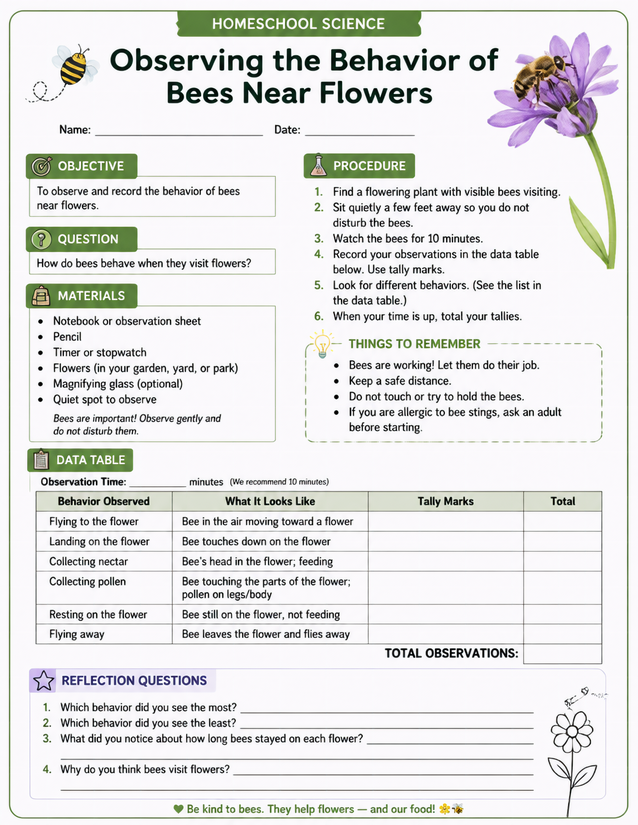
Watch and tally real pollinator activity with this observing bee behavior near flowers worksheet, suited for grades 2-5 homeschoolers.
Getting Started with Observing Bee Behavior Near Flowers

Usage Notes
Nearly every material on the list is already in your home: a pencil, a timer or stopwatch, and access to a flowering plant in a garden, yard, or park. A magnifying glass is listed as optional. The sheet includes a safety note reminding students to keep their distance, avoid touching bees, and check with an adult before starting if they have a bee sting allergy.

Printing Tips
Standard 20 lb copy paper works fine for outdoor use clipped to a clipboard. If your student tends to work through multiple observation sessions across a unit, print a fresh sheet each time rather than laminating, since the tally marks and totals sections need to be written fresh per session.