Creative Minds 𖹭 Happy Hearts

Observing Chemical Reactions Baking Soda and Different Acids
Bubbles rising fast in one cup, barely fizzing in another, and nothing in between until you stir. Observing chemical reactions baking soda produces with three different acids gives your student a vivid, hands-on introduction to acid-base chemistry.
This lab sheet walks grades 4-6 homeschoolers through a structured comparison of how baking soda reacts with white vinegar, lemon juice, and diluted hydrochloric acid. Students record bubble intensity, temperature change, odor, and any other visible changes into a four-column data table, then write a conclusion and respond to a critical-thinking prompt asking why some acids reacted more strongly than others. The question, hypothesis, and background sections frame the purpose before a single measurement is taken.
Observing chemical reactions baking soda experiments like this one fit naturally into a chemistry or matter unit study, whether you are covering states of matter, acids and bases, or gas production. The sheet works as a standalone lab or as a capstone after introducing the concept of chemical versus physical changes. Completing it asks your student to make a prediction, collect real data across three trials, and draw a conclusion supported by their observations, skills that transfer directly into any future lab work.
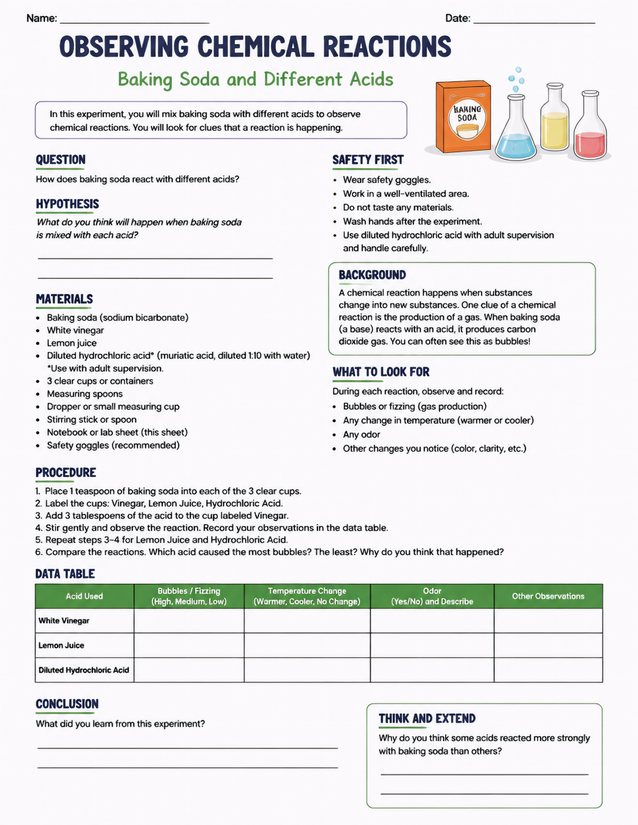
Grades 4-6 homeschoolers test three acids against baking soda while observing chemical reactions firsthand. Includes data table and safety notes.
Investigating Observing Chemical Reactions Baking Soda Lab

Usage Notes
White vinegar and lemon juice are standard pantry items. Diluted hydrochloric acid requires adult supervision and advance preparation: the sheet specifies a 1:10 dilution with water, labeled muriatic acid. The safety section on the sheet calls for goggles, a well-ventilated workspace, and no tasting of any materials, so review those notes with your student before any cups are filled.
Printing Tips
A single loose sheet on a clipboard keeps the data table flat and easy to write on during the experiment. Card stock is not necessary here, but 24 lb paper holds up better than standard copy weight if a cup gets bumped and the surface gets damp.