Creative Minds 𖹭 Happy Hearts

Observing Diffusion with Food Coloring in Water, Timed Intervals
A single drop of food coloring holds still for just a moment before diffusion takes over. Observing diffusion with food coloring in water makes particle movement visible enough to time, sketch, and explain.
Your student fills a glass with room-temperature water, adds one or two drops of food coloring without stirring, then records what they see at four timed checkpoints: start, 30 seconds, 2 minutes, and 5 minutes. The sheet defines diffusion clearly at the top and asks three reflection questions that push students to connect particle behavior to everyday life, making it a solid fit for grades 3-6 science.
As a standalone lab or an anchor activity inside a matter and particles unit study, observing diffusion with food coloring in water gives your homeschooler concrete evidence for an otherwise abstract concept. Completing the observation table and answering the think-and-reflect section demonstrates both careful scientific observation and beginning-level reasoning about concentration gradients. The optional challenge, comparing results in warm versus cold water, opens a natural follow-up conversation about temperature and molecular energy.
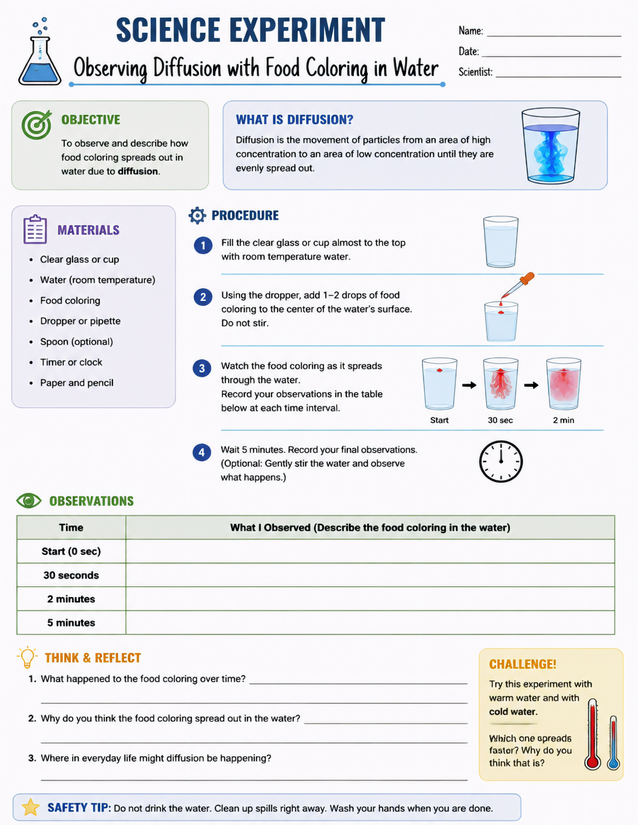
Add one drop and watch particles spread: observing diffusion with food coloring in water suits grades 3-6 homeschoolers beautifully.
Investigating Observing Diffusion with Food Coloring in Water

Usage Notes
Every material on the list is a household item: a clear glass or cup, room-temperature water, food coloring, a dropper or pipette, an optional spoon, a timer, and paper and pencil. The sheet includes a safety tip reminding students not to drink the water, to clean up spills immediately, and to wash hands when finished, so no special supervision beyond standard kitchen-table precautions is needed.

Printing Tips
A single loose sheet on a clipboard works well here since students move between the glass and the recording table during timed intervals. Standard 20 lb copy paper is fine, though 24 lb holds up better if hands are damp from the experiment.