Creative Minds 𖹭 Happy Hearts

Observing Snails and Their Responses to Different Stimuli
Put a live snail in a shallow tray and suddenly science gets very quiet and very focused. This observing snails and their responses lab sheet turns that patience into structured, repeatable data.
Designed for grades 2-5, this lab sheet guides your student through a five-stimulus experiment using live snails as the subject. Your homeschooler writes a hypothesis, then tests water spray, lemon juice or vinegar, salt, gentle touch, and a small piece of lettuce, recording both what the snail did and how many seconds it took to respond for each trial. The observations table keeps data organized across all five stimuli, and the conclusion prompt asks students to synthesize what they noticed into a written response.
This experiment fits naturally into a unit study on animal behavior, invertebrates, or sensory systems, and it works as a standalone hands-on lesson without any prior experiment in the sequence. By completing the sheet, your student demonstrates understanding of stimulus and response relationships, practices timed observation, and gets early experience with the scientific method from hypothesis through conclusion. The observing snails and their responses format is simple enough for younger homeschoolers to follow independently while still producing real, recordable data.
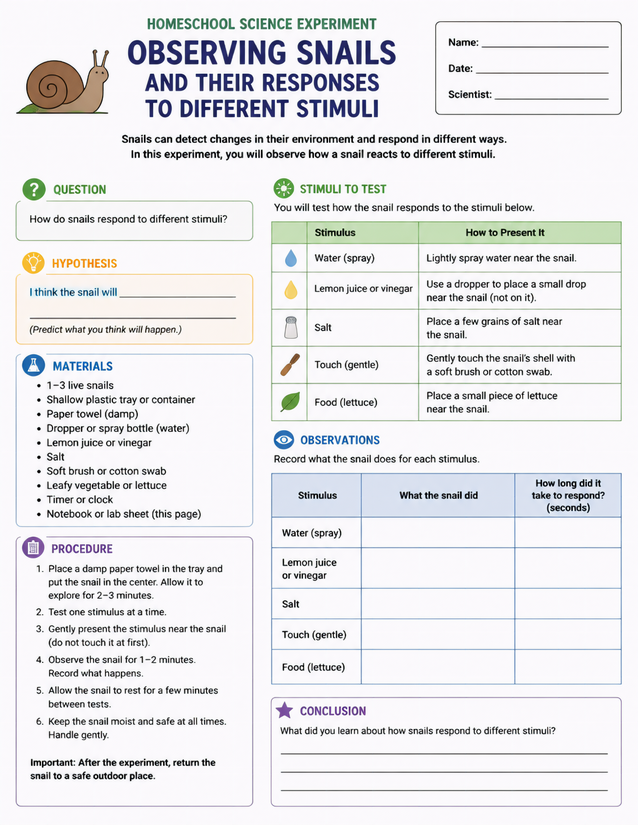
Grades 2-5 homeschoolers record how snails react to water, salt, touch, and food using this observing snails and their responses lab sheet.
Exploring Observing Snails and Their Responses: Lab Setup Guide

Usage Notes
Most materials here are household items: a shallow plastic tray, lemon juice or vinegar, table salt, a soft brush or cotton swab, and lettuce. The one supply that requires advance planning is the live snails, which can usually be collected from a garden after rain. The sheet includes a bold safety note reminding students to keep the snail moist throughout and to return it to a safe outdoor location when the experiment is finished.

Printing Tips
Standard 20 lb printer paper works, but 24 lb holds up better if your student rests a hand on the sheet while timing responses with a clock. Slip it into a plastic page protector inside a lab notebook to protect it from the damp tray nearby.