Creative Minds 𖹭 Happy Hearts

Observing the Photosynthesis Process with Aquatic Plants and Light
Bubbles rising off an aquatic plant are photosynthesis made visible, and observing the photosynthesis process has never been more concrete than watching Elodea in a jar under a bright lamp.
Grades 4-6 homeschoolers work through a structured comparison of how an aquatic plant behaves in two conditions: bright light and complete darkness. Your student fills in a hypothesis, then runs the experiment twice, recording what they see in the observation table, including bubble production, plant appearance, and time observed, plus a hand-drawn sketch for each condition. The sheet also includes three written analysis questions and a Think More prompt asking what other factors might affect photosynthesis in aquatic plants.
This lab fits naturally into a life science or botany unit study, and it stands alone as a self-contained session running roughly 30 to 60 minutes with setup included. By completing it, your student demonstrates understanding of how light drives observing the photosynthesis process and can articulate the difference between the light and dark conditions in their own words, which makes it a strong written assessment alongside the hands-on observation.
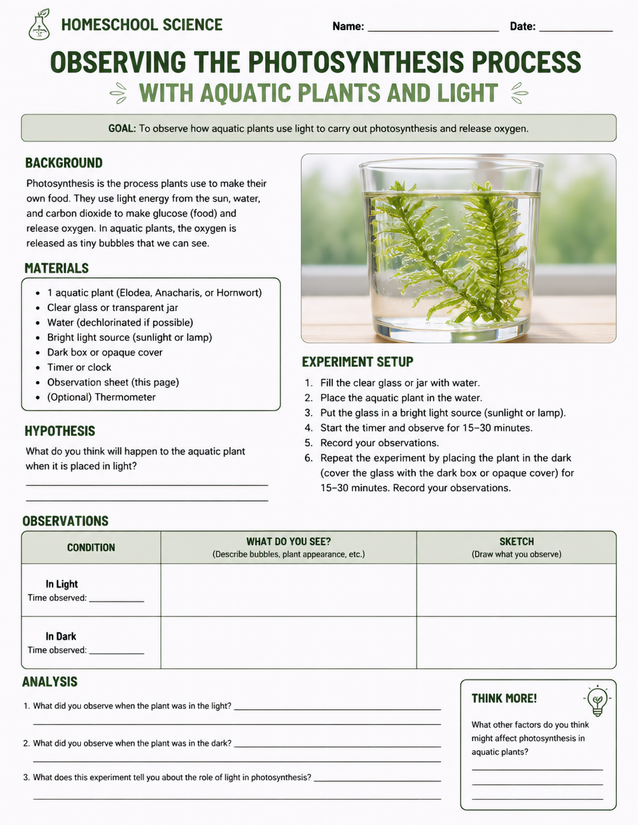
Grades 4-6 homeschoolers use this observing the photosynthesis process lab sheet to compare bubble production in light and dark conditions.
Setting Up Observing the Photosynthesis Process at Home

Usage Notes
Elodea, Anacharis, or Hornwort are listed as the plant options, and all three are common aquarium plants available at pet stores for a few dollars. Everything else on the materials list is a household item: a clear glass or jar, water, a bright lamp or a sunny window, a dark box or opaque cover, and a timer. No specialty supplies are required. No safety concerns are noted on the sheet, though dechlorinated water is recommended and worth preparing a day ahead.

Printing Tips
Standard 20 lb copy paper works for most students, but 24 lb paper holds up better if your homeschooler presses hard while sketching. Slip the sheet into a clipboard for easy use next to the jar during the 15 to 30 minute observation windows, or punch and insert it directly into a science lab notebook after the experiment is complete.