Creative Minds 𖹭 Happy Hearts

Oil and Water Interact with Soap Experiment Lab Sheet
Yellow oil floats, blue water sinks, and one teaspoon of dish soap changes everything. Record it all on this oil and water interact with soap lab sheet built for homeschool science.
Designed for grades 3 to 6, this lab sheet walks your student through a step-by-step investigation into what happens when soap is introduced to a mixture of vegetable oil and water. Your homeschooler fills in a hypothesis before starting, then follows a six-step procedure that includes adding food coloring, pouring oil slowly into the jar, watching the layers form, and finally stirring in dish soap to observe how the mixture responds.
The sheet fits naturally into a chemistry or physical science unit study on mixtures, solutions, and the properties of matter. It works as a standalone lesson or as part of a broader sequence on how surfactants function. By completing the observations and conclusion sections, your student demonstrates understanding of why oil and water separate and how soap acts as an emulsifier to disrupt that separation. Recording the oil and water interact with soap process in writing reinforces both scientific vocabulary and the habit of comparing predictions against results.
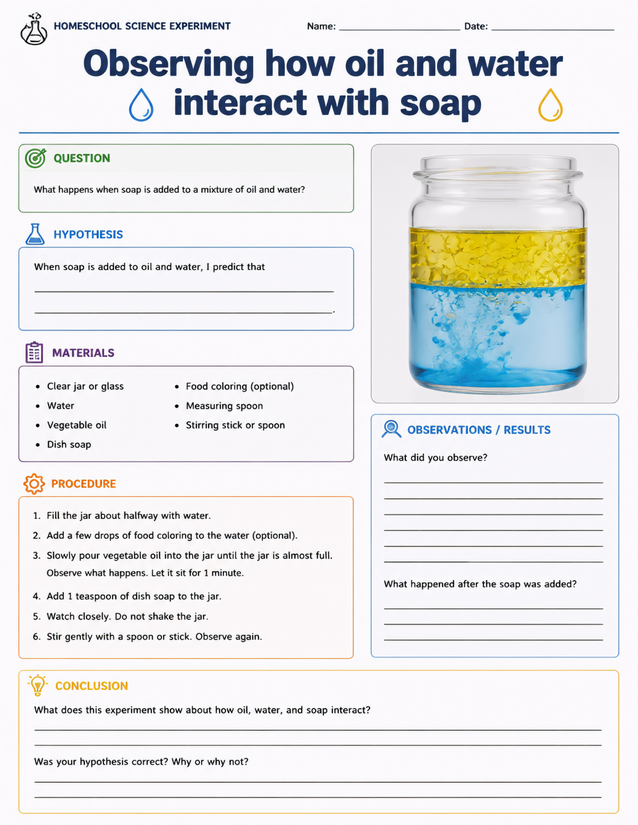
Watch layers separate and merge as your student records how oil and water interact with soap in this grades 3-6 homeschool experiment.
Setting Up the Oil and Water Interact with Soap Lab

Usage Notes
All materials listed on this sheet are common household items: a clear jar or glass, water, vegetable oil, dish soap, a measuring spoon, a stirring stick, and optional food coloring. No specialty supplies are needed, making setup straightforward for any homeschool kitchen. No heat or chemicals beyond standard dish soap are involved, so this experiment is safe for younger students working with light supervision.
Printing Tips
Standard 20 lb copy paper works fine for one-time use, but 24 lb paper holds up better if your student tends to press hard while writing during the experiment. Print as a loose sheet and clip it to a clipboard so it stays flat and accessible on the counter while your homeschooler works through each step.