Creative Minds 𖹭 Happy Hearts

Oil Spills on Bird Feathers Lab Sheet, Waterproofing Experiment
Clean feathers bead water and shed it in seconds. This oil spills on bird feathers lab sheet shows your student exactly what happens when that ability is stripped away.
Your student begins by forming a hypothesis about whether an oiled feather will repel water as well as a clean one, then tests it using two real feathers, cooking oil, a dropper, and water. The data table on this oil spills on bird feathers lab sheet captures the number of drops that beaded and rolled off versus those that soaked in within 30 seconds for each feather, making the difference between the two conditions unmistakably visible. This experiment suits grades 4 through 7 and fits naturally into a life science or environmental science unit.
The sheet works as a standalone lesson or as part of a broader unit study on ecosystems, wildlife conservation, or the chemistry of hydrophobic surfaces. Four analysis questions push your homeschooler past observation and into reasoning, asking why oil contamination matters to birds in the wild. By the time your student writes the conclusion, they have connected a tabletop result to a real environmental consequence.
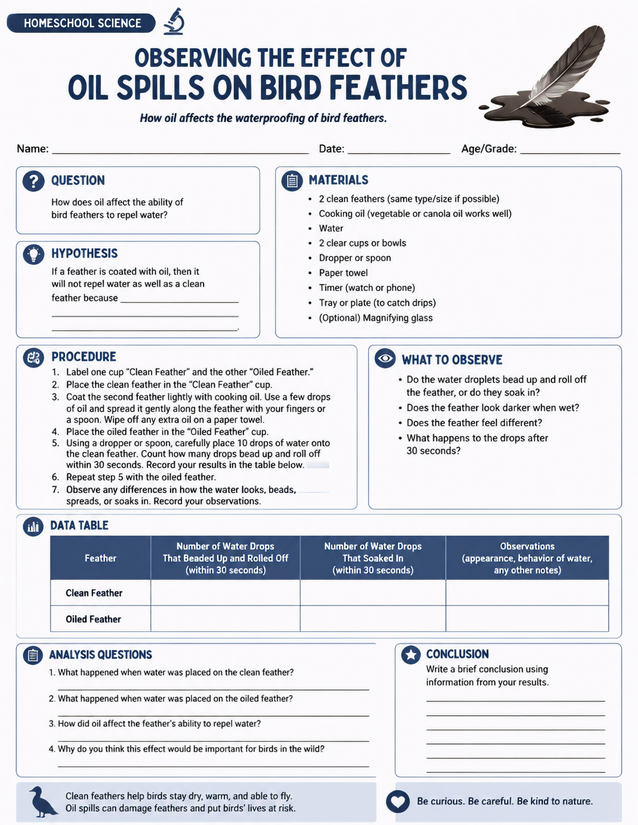
Explore how oil spills on bird feathers lab sheet guides grades 4-7 homeschoolers through a hands-on waterproofing experiment with household materials.
Investigating Oil Spills on Bird Feathers Lab Sheet Results

Usage Notes
Every material listed is a household staple: two feathers, cooking oil, water, clear cups, a dropper or spoon, paper towels, and a timer. An optional magnifying glass lets your student examine the feather structure up close before and after oiling. Because cooking oil is used rather than petroleum, cleanup is simple, though students should keep oiled fingers away from eyes and wash hands after handling the oiled feather.
Printing Tips
A single loose sheet on a clipboard works well here, since students move between two cups during the procedure and need a flat writing surface nearby. Card stock holds up better than standard copy paper if water drips escape the tray, and the data table stays legible even when the sheet picks up a little moisture.