Creative Minds 𖹭 Happy Hearts

Oils on Skin Hydration Lab Sheet, Grades 5-8
Five oils, one forearm, and readings every thirty minutes: the oils on skin hydration lab gives your student real data to compare instead of just a list of facts to memorize.
This lab sheet walks grades 5-8 homeschoolers through a structured comparison of five oils, including coconut, olive, almond, jojoba, and grapeseed, on skin moisture retention over four hours. Your student records baseline moisture readings, applies each oil to a labeled forearm section using a cotton swab, then measures again at 30 minutes, 2 hours, and 4 hours. The data table and analysis questions guide them from raw numbers toward pattern recognition and evidence-based conclusions.
The oils on skin hydration lab fits naturally into a biology or chemistry unit covering skin as an organ, lipids, or consumer science. It works as a standalone investigation or as a companion to a broader unit study on the integumentary system. By the time your student fills in the conclusion section, they have practiced forming a hypothesis, executing a controlled procedure, and defending a recommendation with their own recorded data.
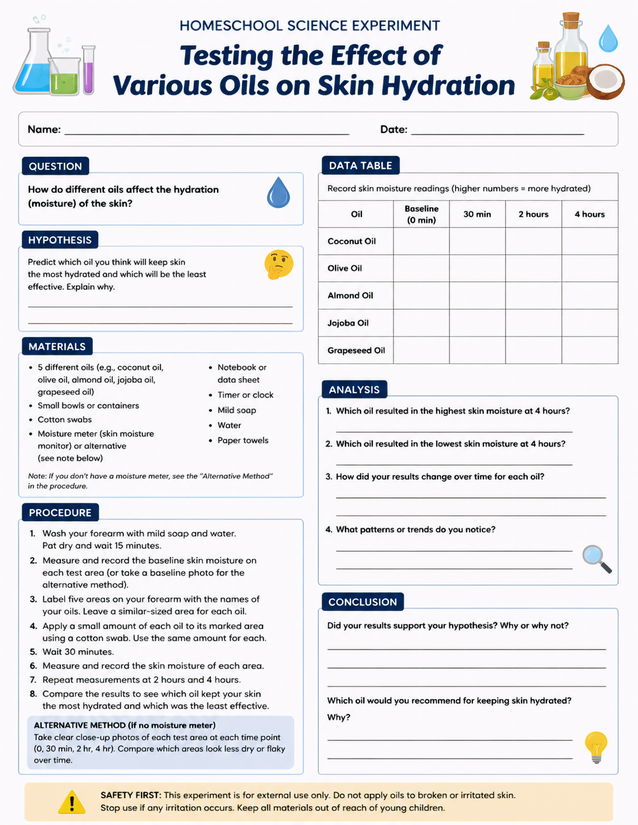
Comparing oils on skin hydration over four hours, this homeschool science experiment uses coconut, olive, almond, jojoba, and grapeseed oil. Grades 5-8.
Getting Started with the Oils on Skin Hydration Lab

Usage Notes
All five oils listed, coconut, olive, almond, jojoba, and grapeseed, are household pantry or drugstore items for most families. Cotton swabs, small bowls, mild soap, water, and paper towels round out the materials list. A skin moisture meter is listed as the primary measurement tool, but the sheet includes a clearly explained alternative method using close-up photos for families who do not own one.

Printing Tips
A single copy on standard 20-pound paper works well here since students write through the session in stages rather than all at once. Tuck the sheet into a clipboard so it stays flat during the four-hour measurement window, or three-hole punch it to file directly into a science lab notebook once complete.