Creative Minds 𖹭 Happy Hearts

Paper Bridge Design Strength Test, Homeschool Science Lab Sheet
Four bridge designs, one question, and a stack of coins standing between your student and a real engineering answer. The paper bridge design strength test turns a few sheets of printer paper into a structural challenge worth recording.
Structured around the question of which folded paper configuration can hold the most weight before collapsing, this lab sheet walks grades 4-6 students through a full scientific method cycle. The printed question asks which paper bridge design holds the most weight before it breaks, and the hypothesis section invites your student to commit to a prediction before testing begins. The data table tracks four named or sketched bridge designs across two test runs each, recording maximum weight held in grams and calculating an average, then ranking the designs from strongest to weakest.
The paper bridge design strength test fits naturally into a physics or engineering unit study focused on forces, load distribution, and structural design. It works as a standalone hands-on activity or as an anchor experiment within a broader simple machines and structures sequence. Completing the sheet, your student demonstrates the ability to control variables, repeat trials for accuracy, interpret comparative data, and draw evidence-based conclusions about which physical structure performed best and why.
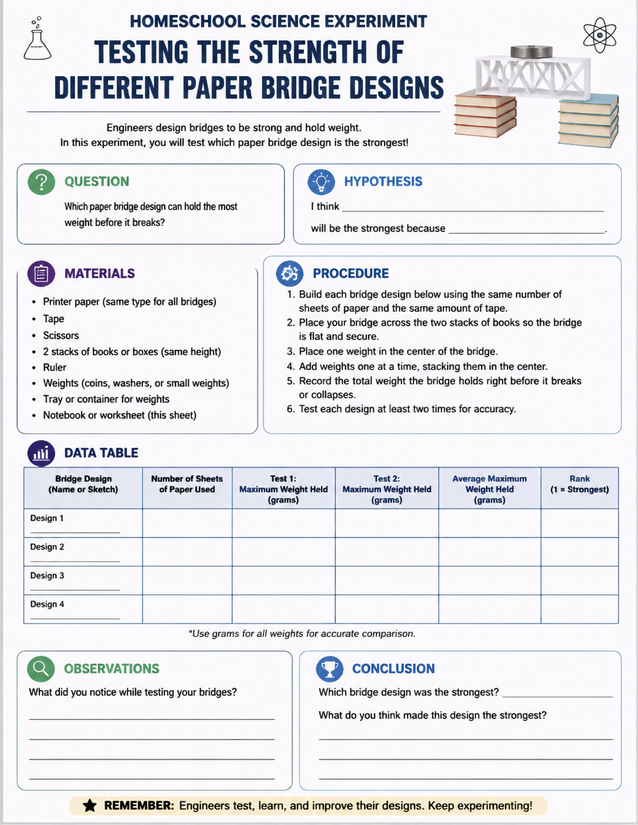
Which paper bridge design holds the most weight? This paper bridge design strength test lab sheet is ideal for grades 4-6 homeschoolers.
Recording Results for the Paper Bridge Design Strength Test

Usage Notes
Printer paper, tape, scissors, a ruler, and two same-height stacks of books or boxes make up the test setup. Weights such as coins, washers, or small calibrated weights are placed one at a time in the center of each bridge, so having a small tray or container to hold them safely is worth gathering before you start. All materials are standard household items, and no safety hazards are implied beyond keeping scissors away from younger siblings watching the experiment.

Printing Tips
Twenty-four-pound copy paper gives students enough surface firmness to write gram totals clearly during the experiment without the sheet buckling under a clipboard. Print one sheet per student so each can record their own two test runs, rather than sharing a single data table as a group.