Creative Minds 𖹭 Happy Hearts

Phototropism of Plants Toward Light, Homeschool Lab Sheet
Bean seeds, a cardboard box, and a single lamp reveal exactly how the phototropism of plants toward light actually works, day by day, in measurable centimeters.
Your student investigates the phototropism of plants toward light by running a side-by-side comparison: one seedling pot exposed to light from all directions as a control, and one placed inside a dark box with light entering from a single side. Over seven days, your homeschooler records height in centimeters and direction of growth for both plants, then sketches what they observe in two labeled drawing boxes. This experiment is well-suited for grades 4 through 6 and asks students to move from a testable question to a written hypothesis before a single seed goes into the soil.
The sheet fits naturally into a botany or plant biology unit study, and it works equally well as a standalone lesson on plant responses and tropisms. Completing the analysis section requires your student to compare the two growth patterns, evaluate whether the results supported the hypothesis, and draw a broader conclusion about how plants respond to environmental cues. That progression from setup to conclusion mirrors scientific method practice your homeschooler can carry into more complex experiments.
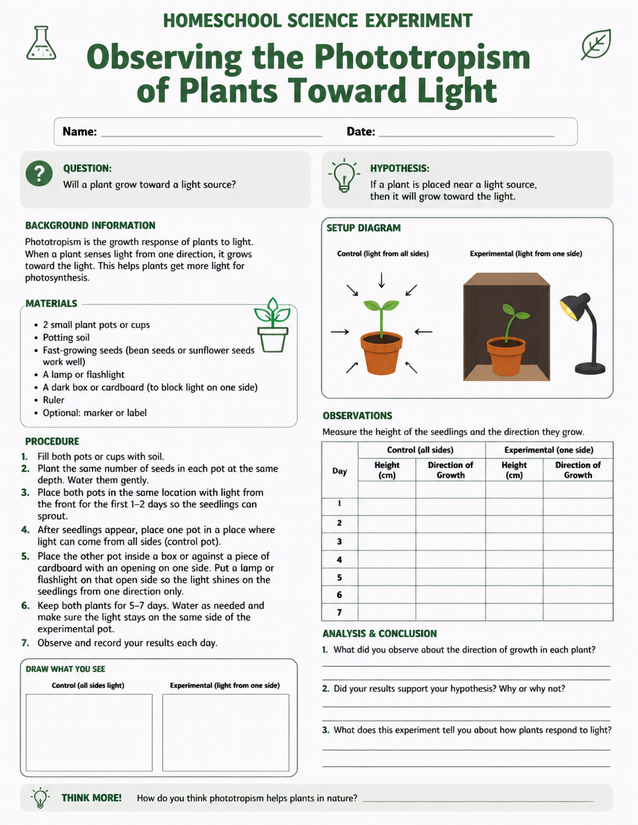
Grades 4-6 homeschoolers study the phototropism of plants toward light using bean seeds, a dark box, and a lamp over seven days.
Investigating Phototropism of Plants Toward Light, Step by Step

Usage Notes
Most materials here are household items your family likely already has: small pots or cups, potting soil, a ruler, and a lamp or flashlight. Fast-growing seeds such as bean or sunflower seeds are the only purchase needed, and both are inexpensive at garden centers. The dark box is made from cardboard with a hole cut on one side, so no specialty supplies are required. No safety concerns are noted on the sheet beyond standard plant-handling care.
Printing Tips
A standard 20 lb copy paper works for most students, but 24 lb paper holds up better if your homeschooler presses firmly while measuring and recording daily. Printed as a loose sheet clipped to a clipboard, it can sit beside the experiment pots for easy daily entry without taking up notebook space.