Creative Minds 𖹭 Happy Hearts

Pill Bugs in Humid Versus Dry Environments, Observation Lab
Roly-polies have a strong opinion about moisture, and pill bugs in humid versus dry environments is exactly the kind of live-animal experiment that makes your homeschooler stop and actually look.
This lab sheet guides your student through a controlled comparison of pill bug location choices when given access to both a humid side and a dry side of a single container. Your homeschooler formulates a hypothesis, records bug counts every five minutes across three separate trials, calculates averages, and writes a conclusion about whether the results matched their prediction. The sheet suits grades 3-5 and introduces data collection, fair testing, and animal behavior as a science concept in one tidy session.
The pill bugs in humid versus dry environments experiment works well as a standalone unit study activity or as an entry point into a broader invertebrate or ecology unit. Because the procedure repeats across three trials and asks students to average their results, it also builds early data literacy without requiring any prior lab experience. A completed sheet demonstrates that your student can design a fair test, record quantitative observations, and connect evidence to a scientific claim.
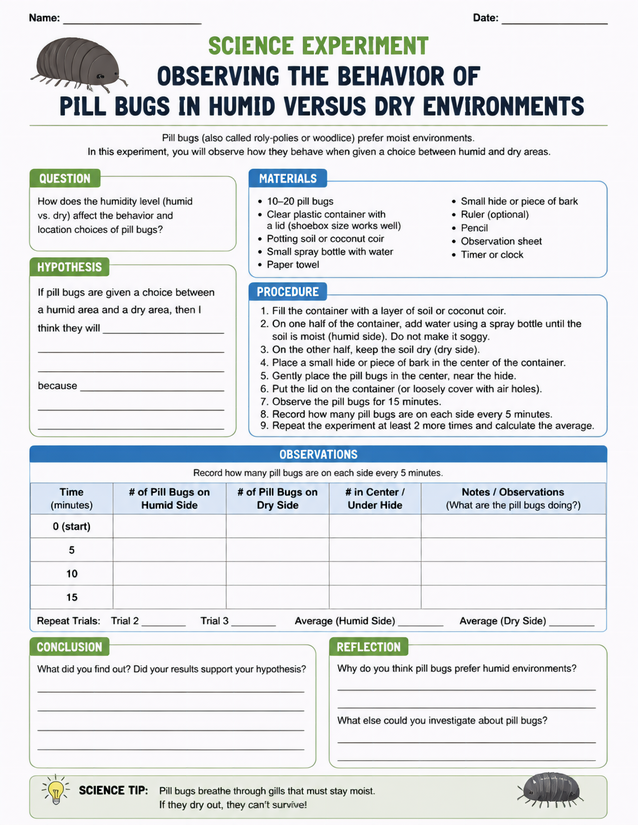
Grades 3-5 homeschoolers record pill bug behavior across humid and dry environments. Three timed trials, built-in data table, instant download.
Investigating Pill Bugs in Humid Versus Dry Environments

Usage Notes
Most materials on this sheet are already at home: a shoebox-sized container with a lid, potting soil or coconut coir, a small spray bottle, paper towel, and a pencil. You will need to collect 10-20 live pill bugs from a garden or yard, which are easy to find under logs, rocks, or damp leaf litter. No chemicals are involved, but remind your student to handle the bugs gently and wash hands after the experiment.
Printing Tips
Standard 20 lb copy paper works here since students are writing counts into a table rather than pressing hard with a pencil. Slip the sheet into a plastic page protector if you want to reuse the observation table across the three trials on a dry-erase surface, then have your student transfer averages to a fresh printed copy for the conclusion and reflection sections.