Creative Minds 𖹭 Happy Hearts

Planarian Worm Regeneration Lab Sheet, 7 to 14 Day Observation
Cut a flatworm into three pieces and watch each one grow back what it lost. This planarian worm regeneration lab sheet guides your student through 7 to 14 days of daily measurement and close observation.
Planarians are freshwater flatworms capable of regrowing an entire body from a single fragment, and this lab sheet puts that biological marvel directly in your student’s hands. Your homeschooler cuts one planarian into two or three pieces just behind the eyes, in the middle, and near the tail end, then tracks head regrowth, tail regrowth, and length in millimeters across daily observation entries. Designed for grades 6-8, the planarian worm regeneration lab sheet pairs naturally with a unit study on cell biology, animal adaptation, or invertebrate zoology.
The sheet works well as a multi-week standalone investigation or as an anchor experiment within a broader biology sequence on regeneration and cellular repair. Four structured reflection questions ask your student to compare regeneration speed across pieces, reason about which body segment matters most for survival, and draw conclusions from their own recorded data. Completing it demonstrates scientific patience, consistent observation habits, and the ability to connect raw measurements to a biological principle.
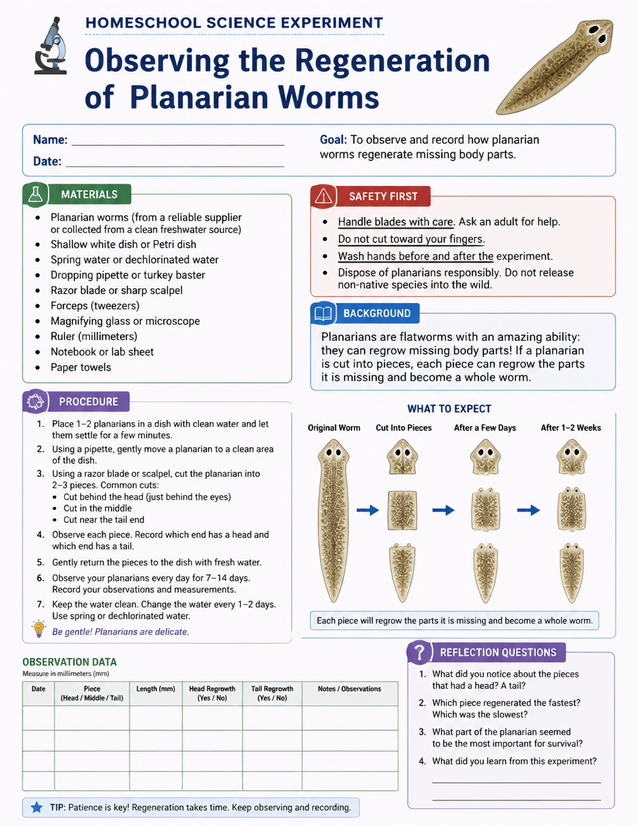
Record head and tail regrowth daily with this planarian worm regeneration lab sheet, suited for grades 6-8 homeschoolers studying flatworm biology.
Setting Up Your Planarian Worm Regeneration Lab Sheet

Usage Notes
Planarians must be sourced from a reliable biological supplier or a clean freshwater habitat, which makes this a specialty supply item rather than a household one. The sheet also calls for a razor blade or sharp scalpel, forceps, a dropping pipette, spring or dechlorinated water, and a shallow white dish or petri dish. The safety panel explicitly warns students to handle blades with adult supervision, cut away from fingers, and dispose of planarians responsibly without releasing them into local waterways.

Printing Tips
Standard 20 lb copy paper works for the observation table, but 24 lb paper holds up better if your student’s hand rests on the sheet while writing daily entries over two weeks. Punch the completed sheet and insert it into a dedicated biology lab notebook so the full 7-to-14-day record stays together as one artifact.