Creative Minds 𖹭 Happy Hearts

Reading a Calendar Worksheet, May 2024
Sundays, Saturdays, and everything in between: this reading a calendar worksheet gives your student a real monthly grid to work from, not just abstract date vocabulary.
Built around a fully printed May 2024 calendar, this reading a calendar worksheet walks students through nine question sets covering day identification, date counting, ordinal date writing, forward-and-backward day counting, and a multi-step elapsed-days problem. A brief key fact box at the top reviews week structure and month lengths before students begin. Grades 2 through 3 are the sweet spot, though a confident second-grader or a student who needs calendar reinforcement in a unit study on time and measurement will get full use from every section.
The worksheet moves from simple recall questions (What day of the week is May 1?) toward applied reasoning (10 days after May 15, how many days between two birthdays). That progression makes it practical for independent practice once you have introduced calendar reading, or as a guided activity the first time through. Your student practices locating specific dates on a grid, computing intervals, and showing arithmetic work in the dedicated show-your-work box for question nine.
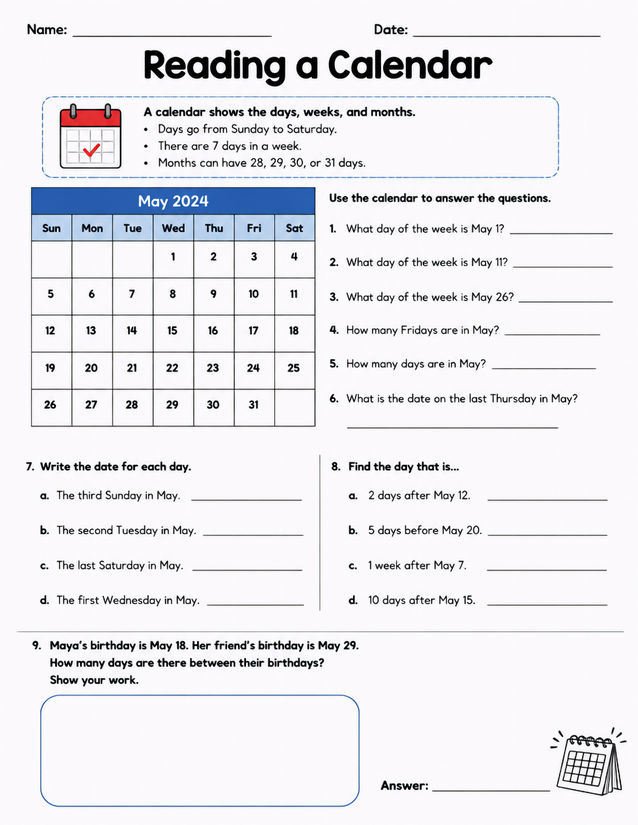
Sharpen date math skills with this reading a calendar worksheet built around May 2024, suited for grades 2-3 homeschoolers.

Usage Notes
A pencil works best here since students will be writing short answers on lines and working arithmetic in the show-your-work box. The nine questions range from quick lookups to a subtraction problem, so guided instruction suits a first attempt while independent practice fits review sessions.

Printing Tips
Standard 8.5 by 11 portrait orientation keeps the calendar grid and question columns legible without scaling. Printing a small set of copies lets your student retry the elapsed-days section until the mental math clicks.