Creative Minds 𖹭 Happy Hearts

Rounding to the Nearest Thousand Worksheet, Grades 4-5
Four worked examples sit right at the top of this page, so your student can reference the rounding rule without asking you twice. That built-in scaffold makes the rounding to the nearest thousand worksheet genuinely independent-friendly.
Three sections move your student from guided practice to applied thinking. The reference box explains the hundreds-digit rule clearly, with examples like 3,456 rounded to 3,000 and 9,615 rounded to 10,000. Sections one and two each offer ten problems in a two-row grid format, covering four-digit and five-digit numbers, making this rounding to the nearest thousand worksheet well suited for grades 4 and 5.
The third section adds two word problems, one about a library’s book count and one about zoo visitors, so your student practices translating a real context into a rounding decision rather than just filling in blanks. This is a natural fit for a number sense unit study or as a standalone practice page on a math morning. Students build the habit of identifying the hundreds digit first, then deciding which thousand is closer.
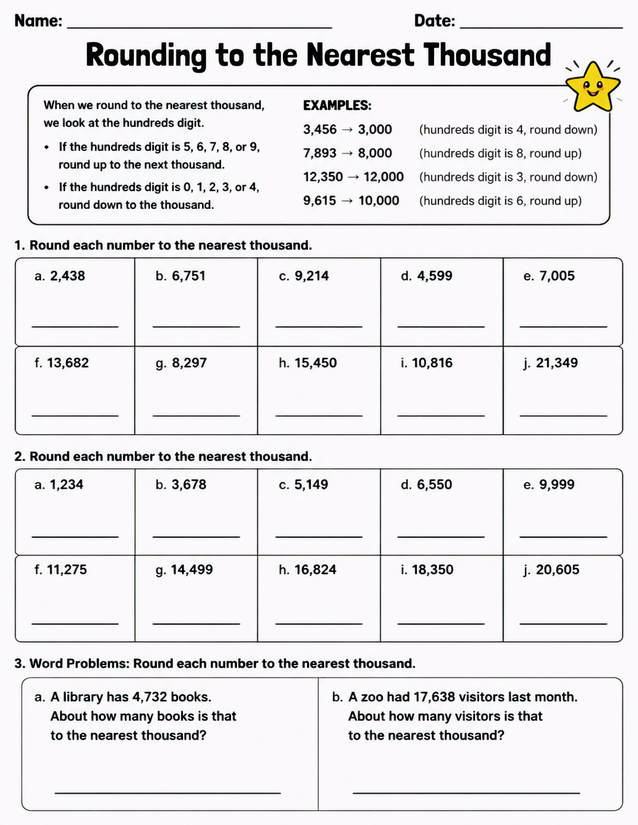
Grades 4-5 rounding to the nearest thousand worksheet with a reference box, twenty problems, and two word problems. Instant download.
Getting the Most from Your Rounding to the Nearest Thousand Worksheet

Usage Notes
A pencil with a good eraser suits the answer blanks in the grid sections, since students often second-guess the hundreds digit and need to revise. The reference box makes this manageable for independent work once your student has had one guided walkthrough of the rule. For students who are newer to five-digit numbers, sit alongside them for section one before releasing them to finish on their own.

Printing Tips
Twenty-four pound paper handles pencil erasing better than standard copy paper, which matters when students are self-correcting. Print one sheet per student rather than front-to-back, since the layout fills the full portrait page.