Creative Minds 𖹭 Happy Hearts

Ruler Drop Reaction Time Test, Homeschool Science Lab Sheet
Catch the ruler, record the centimeters, and find out exactly how fast your brain is wired. The ruler drop reaction time test turns a single 30 cm ruler into a genuine neuroscience experiment.
The ruler drop reaction time test asks your student to work with a partner, dropping and catching a standard 30 cm ruler without warning while recording where their fingers caught it in centimeters. Five timed trials build a data set students average together, then four written analysis questions push them to interpret whether their reaction time is fast, average, or slow and to identify variables like tiredness, focus, or distraction that may have shifted their results. This sheet is well matched to grades 4 through 7 and fits naturally into a human body or neuroscience unit study.
Used as a standalone homeschool worksheet, it covers the full scientific method from hypothesis to written conclusion, making it easy to assign without additional prep. Your homeschooler demonstrates an understanding of how the nervous system processes sensory input by connecting their measured reaction distance to a real biological explanation, since the sheet explains that a shorter catch distance means a faster response. A tips-for-fair-results sidebar also introduces your student to experimental controls, reinforcing why consistent hand position and multiple trials matter.
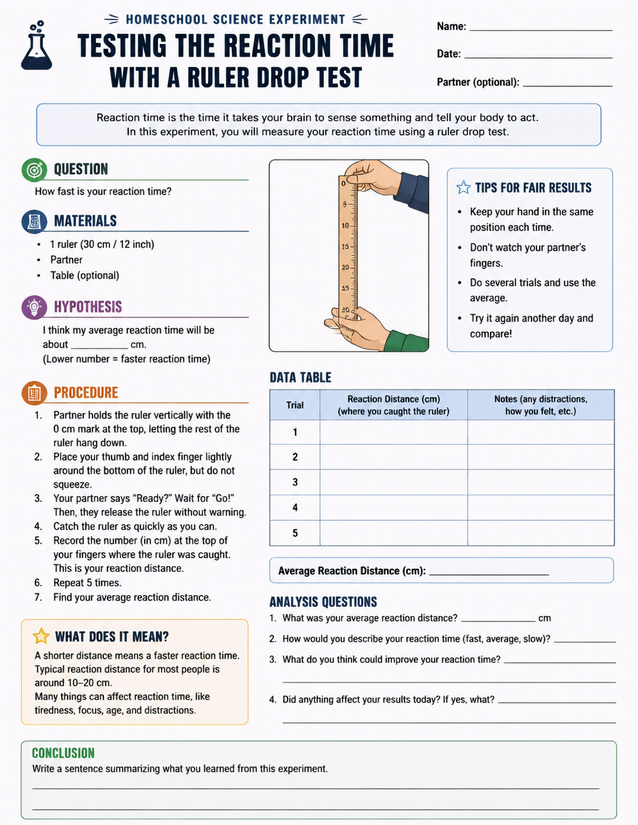
Measure how fast your brain responds with the ruler drop reaction time test, ideal for grades 4 to 7 homeschoolers.
Getting Started with the Ruler Drop Reaction Time Test

Usage Notes
One 30 cm ruler and a willing partner are the only materials this experiment requires, both of which are standard household items. No specialty supplies, open flames, or chemicals are involved, making this one of the lower-barrier labs in a physical science or biology unit. The sheet does note that students should not watch their partner’s fingers, which is worth a quick reminder before trials begin to keep results honest.

Printing Tips
Standard 20 lb copy paper is fine here since students write lightly in small data table cells. Slip the sheet into a plastic page protector inside a lab notebook, or keep it loose for easy reference on a table during the partner activity.