Creative Minds 𖹭 Happy Hearts

Sea Star Regeneration Lab Sheet, Cut Pieces Observation
Arm pieces that grow into whole animals sound like science fiction, but a sea star regeneration lab sheet turns that biology into something your student can watch happen in real time.
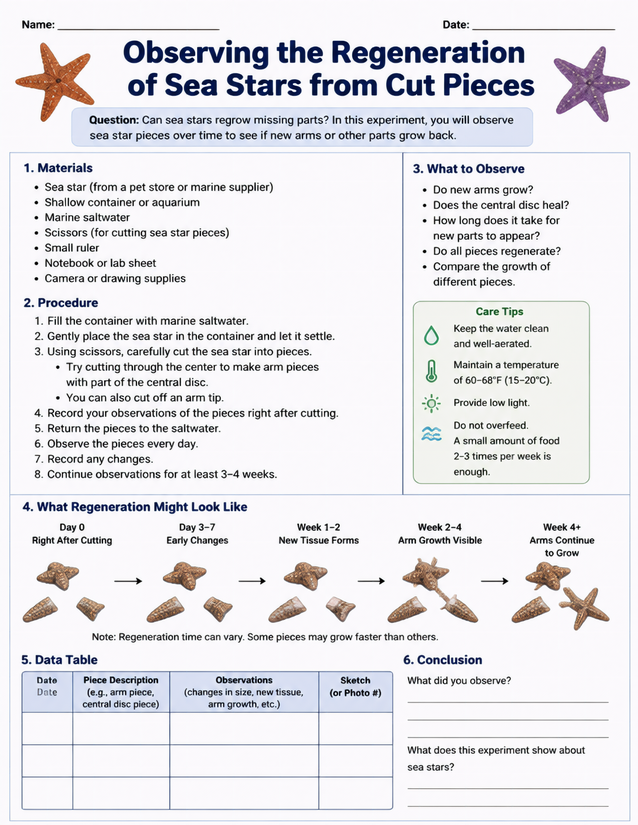
Your student records the regrowth of sea star arms over three to four weeks using this structured lab sheet for grades 5-8. The sheet opens with the guiding question of whether sea stars can regrow missing parts, then walks through materials, a cutting procedure, and a five-stage visual timeline showing changes from Day 0 right through Week 4 when arms continue to grow. The observation section asks students to track whether new arms appear, whether the central disc heals, how long regrowth takes, and whether all pieces regenerate equally, pushing beyond simple yes-or-no results.
The sea star regeneration lab sheet fits naturally into a marine biology unit study or a broader life science sequence covering animal adaptations and tissue repair. A data table with columns for piece description, observations, and sketch or photo number keeps daily records organized across the full observation window. The conclusion section asks two written responses, one about what the student observed and one about what the experiment reveals about sea stars, giving you a simple assessment checkpoint without writing a separate prompt.
Can severed arms actually grow back? This sea star regeneration lab sheet guides grades 5-8 through a multi-week live observation. Instant download.
Getting Started with Your Sea Star Regeneration Lab Sheet

Usage Notes
A live sea star sourced from a pet store or marine supplier is the key material, and it is a specialty item that requires planning ahead. The sheet also calls for a shallow container or aquarium, marine saltwater, scissors, a small ruler, and a camera or drawing supplies. Care tips printed on the sheet specify keeping water clean and aerated, maintaining 60 to 68 degrees Fahrenheit, providing low light, and feeding only a small amount two to three times per week, so review those with your student before the first cut.

Printing Tips
Standard 20-lb copy paper works for daily data entries, but 24-lb paper holds up better if the sheet sits near a wet aquarium. Print one sheet per observation window and keep it loose on a clipboard beside the tank so your student can record changes quickly during each daily check.