Creative Minds 𖹭 Happy Hearts

Simple Alarm Circuit with Tripwire Homeschool Science Lab
Cut the string and the alarm sounds. A simple alarm circuit with tripwire puts real electronics logic into your student’s hands in one afternoon.
This lab walks your student through building a simple alarm circuit with tripwire using a 9V battery, a piezo buzzer, eye screws, alligator clip jumper wires, and a length of string stretched taut across a cardboard or wood base. The sheet explains the core concept clearly: the tripwire holds the circuit open and silent, and breaking it closes the circuit and triggers the alarm. Observations prompt your student to record what happened with the string intact versus broken, and three analysis questions push them to explain why, connecting cause to circuit behavior. It sits well in a grades 5 to 8 unit on electrical circuits or physical science.
As a standalone lesson, the simple alarm circuit with tripwire demonstrates open and closed circuit logic in a way that a diagram alone never does. Your student finishes the lab able to describe how real-life security systems use the same switching principle, which makes it a strong addition to a technology or engineering unit study. The lab sheet keeps the procedure sequenced in eight numbered steps so you can hand it off and supervise without scripting every moment.
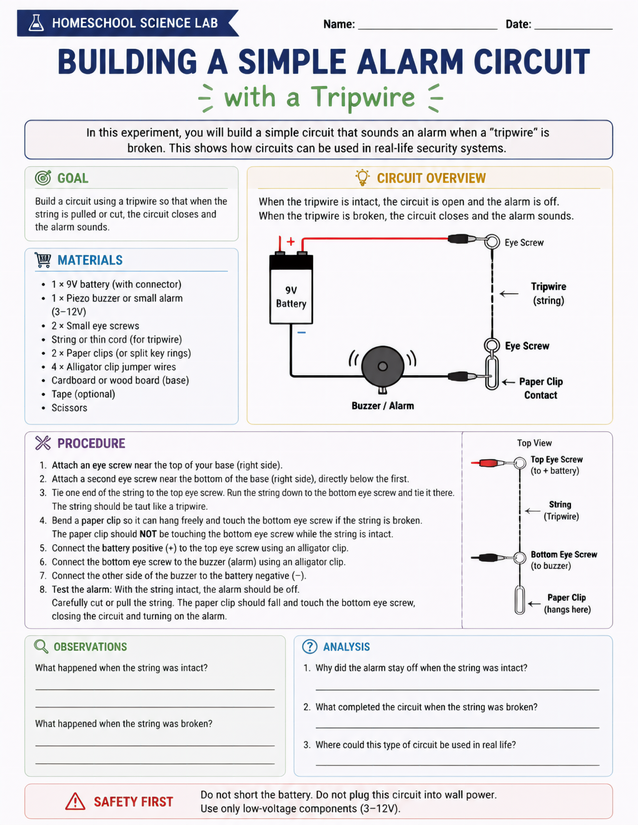
Wire up a simple alarm circuit with tripwire in this hands-on homeschool science lab for grades 5 to 8.
Setting Up Your Simple Alarm Circuit with Tripwire

Usage Notes
Alligator clip jumper wires and a 9V battery connector are the two items most likely to require a quick hardware or electronics store trip. The string, paper clips, cardboard, tape, and scissors are ordinary household supplies. A safety note on the sheet reminds students not to short the battery and to use only low-voltage components rated 3 to 12 volts.

Printing Tips
Twenty-four pound copy paper handles the writing load in the observations and analysis sections without trouble. The sheet works best as a loose page on a clipboard during the build, then filed into a lab notebook once complete. Laminating is not recommended here since students need to write directly in the observation and analysis fields.