Creative Minds 𖹭 Happy Hearts

Sleep Duration Effect on Memory Lab Sheet, Grades 5, 7
Four hours of sleep versus eight and a word-recall test: the sleep duration effect on memory turns bedtime into a real data-collection opportunity your student can run across three nights.
Structured around three sleep conditions of 4, 6, and 8 hours, this lab asks your student to study a list of 20 to 30 unrelated words, take a 10-minute break, then record how many they can recall after each night. The data table tracks words remembered alongside notes on energy and alertness, so the numbers connect to a physical experience your student already knows. This sleep duration effect on memory experiment suits grades 5 through 7 and fits naturally into a biology or health science unit.
Because each trial runs over a separate night, the experiment unfolds across roughly a week, making it a strong standalone investigation rather than a single-session lab. Your homeschooler practices controlling variables, following a consistent procedure, and interpreting self-collected data before writing a conclusion and a reflection on what they would improve next time. Completing the sheet demonstrates understanding of sleep science basics and the experimental process from hypothesis to conclusion.
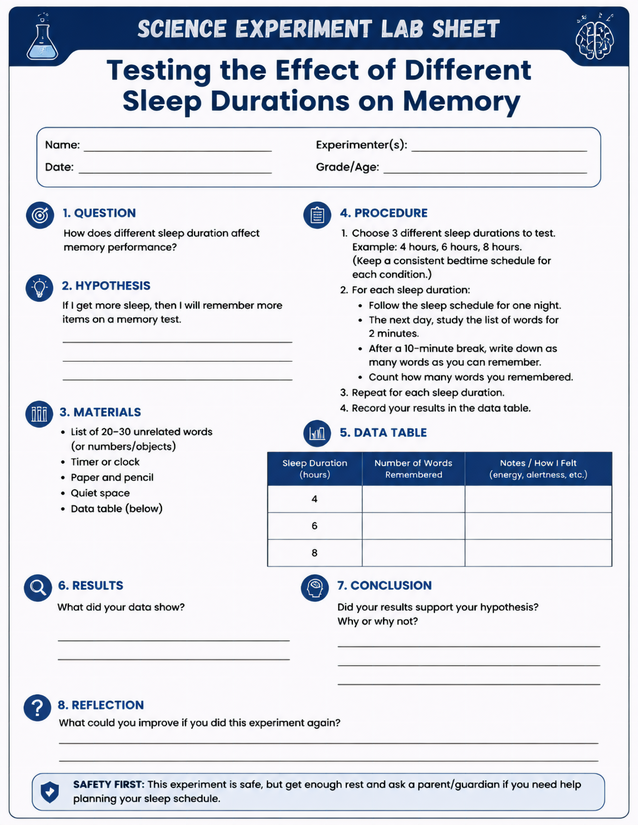
Grades 5-7 homeschoolers test the sleep duration effect on memory across three conditions. All materials are household items.
Setting Up the Sleep Duration Effect on Memory Experiment

Usage Notes
Every material on the list is already in most homes: paper, a pencil, a timer or clock, and a quiet space. Your student also creates the word list themselves, so no specialty supplies are needed. The sheet includes a safety note reminding students to get adequate rest and to check with a parent if they need help planning the sleep schedule.

Printing Tips
Standard copy-weight paper is fine here since students write between sessions rather than during a single active lab. Printing one sheet and inserting it into a lab notebook keeps all three nights of data in one place, or punch holes and add it to a science binder after the final trial.