Creative Minds 𖹭 Happy Hearts

Solar Oven from a Pizza Box, Homeschool Science Experiment
Sunlight, a pizza box, and aluminum foil: building a solar oven from a pizza box turns your backyard into a working kitchen and your student’s data table into real evidence of heat transfer.
Your student constructs a functional solar oven from a pizza box lined with aluminum foil and black construction paper, then tests it on chocolate pieces, marshmallows, or graham crackers placed in an oven-safe pan. The experiment sheet walks through a nine-step procedure and asks students to log temperature in degrees Fahrenheit every 10 to 15 minutes across eight time intervals, from zero to 120 minutes, answering the central question of how hot the solar oven from a pizza box can actually get. This lab fits grades 4 through 7 and pairs naturally with energy, heat transfer, or renewable energy unit studies.
Beyond the build, the sheet prompts a written hypothesis, structured observations about temperature change and food behavior, and a conclusion asking whether the hypothesis held up. Completing it demonstrates that your homeschooler can collect time-series data, draw evidence-based conclusions, and connect a hands-on build to underlying science concepts. It works as a standalone afternoon experiment or as the centerpiece of a solar energy unit.
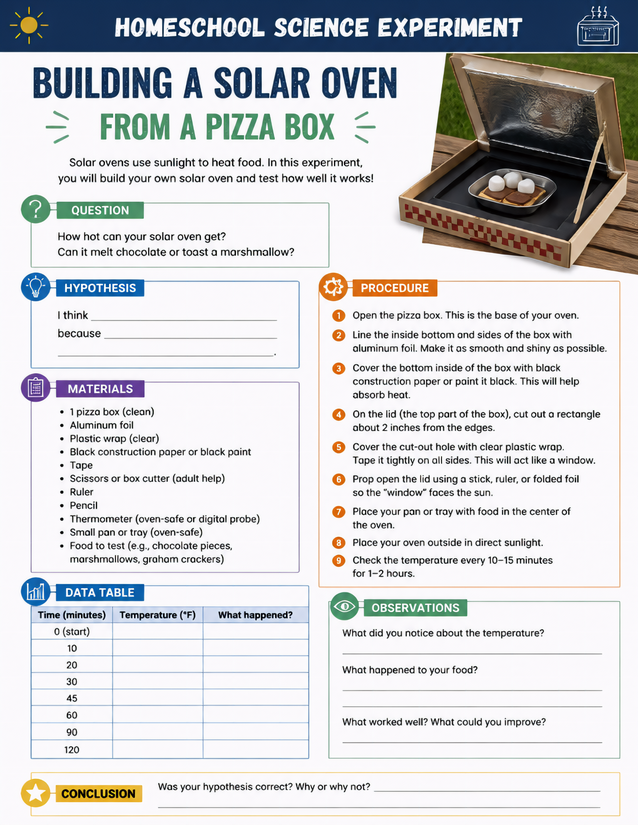
Can sunlight melt chocolate? This solar oven from a pizza box experiment guides grades 4-7 homeschoolers through building, testing, and recording real temperature data.
Recording Results for Your Solar Oven from a Pizza Box

Usage Notes
Household supplies cover most of the build: a clean pizza box, aluminum foil, clear plastic wrap, tape, scissors, a ruler, a pencil, and black construction paper or black paint. The one specialty item worth sourcing ahead of time is an oven-safe thermometer, either a probe-style digital thermometer or a small oven thermometer that fits inside the box. Step four involves cutting a rectangle in the lid with scissors or a box cutter, so adult supervision is noted directly on the sheet for that step.

Printing Tips
Standard 24-pound copy paper works for this sheet since students are writing indoors before and after the experiment rather than outside in the elements. If your homeschooler will carry the sheet out to the backyard during temperature checks, slipping it into a clipboard with a sturdy backing keeps it flat and wrinkle-free while they record readings every ten minutes.