Creative Minds 𖹭 Happy Hearts

Solubility of Different Substances in Water Lab Sheet
Salt dissolves, sand doesn’t, and your student gets to figure out exactly why. Recording the solubility of different substances in water teaches chemistry concepts with nothing fancier than a spoon and a cup.
Six substances, six cups, and one structured recording table make this the kind of lab your grades 4-6 student can own from start to finish. The sheet walks them through a written hypothesis, a six-step procedure, and a results table that tracks what happened when each substance was stirred, whether it dissolved, what residue remained, and how clear or cloudy the water looked afterward. Testing the solubility of different substances in water at this level puts observable chemistry into a format your homeschooler can reason through independently.
This lab works well as a standalone introduction to solutions and mixtures, or as an anchor activity inside a broader chemistry or matter unit study. By the time your student fills in the observations and conclusion sections, they have moved from prediction to pattern recognition, which is the real skill the sheet is designed to demonstrate. The structured format means you can check reasoning, not just answers.
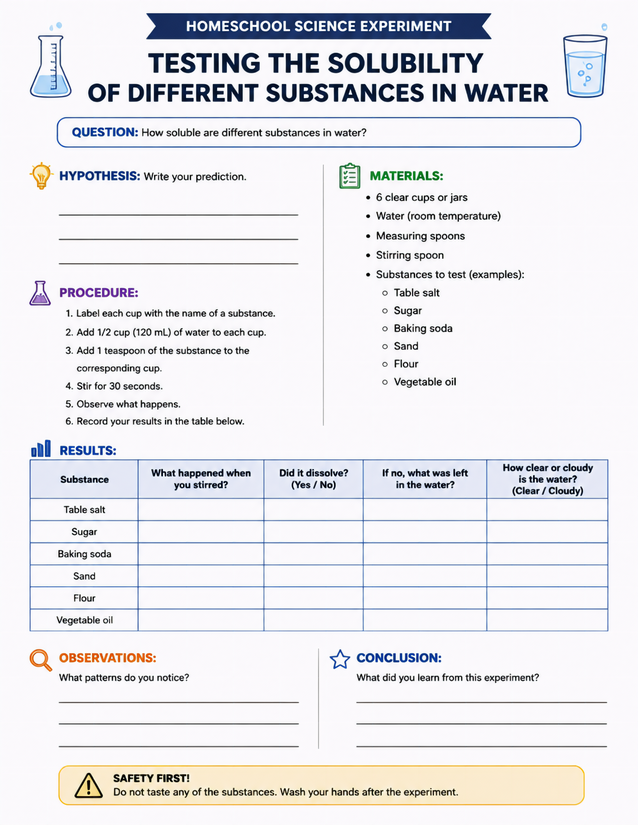
Six common kitchen materials, one recording table: the solubility of different substances in water experiment suits grades 4-6 homeschoolers beautifully.
Investigating Solubility of Different Substances in Water

Usage Notes
Every material on the list is a household staple: table salt, sugar, baking soda, sand, flour, and vegetable oil, plus six clear cups or jars, measuring spoons, and a stirring spoon. Room-temperature water is specified, so no heat source is involved. The safety note on the sheet is direct: no tasting the substances, and hands should be washed when the experiment is done.

Printing Tips
Standard 20-lb copy paper is fine here since students are writing brief observations rather than applying pressure. A loose sheet on a clipboard keeps it accessible during the experiment, and the results table is sized well for neat handwriting in each cell.