Creative Minds 𖹭 Happy Hearts

Observing the Spectrum of Different Light Sources Lab Sheet
Sunlight, a fluorescent bulb, and an LED walk into a diffraction grating and turn out to be completely different things. Recording those differences is exactly what this spectrum of different light sources lab sheet is built for.
Students compare how the spectrum of different light sources appears when each one is viewed through a transmission diffraction grating. The sheet guides them through building a simple cardboard viewing setup, aiming five light sources at a white screen, and measuring the distance from the center white spot to both the red and violet edges of each spectrum. Data rows are included for sunlight, an incandescent bulb, a white LED, a fluorescent or CFL bulb, a computer or phone screen, and one open row for an additional source. Five analysis questions push students to distinguish continuous spectra from line spectra and reason about what the color differences reveal. This experiment suits grades 5 through 8 and pairs naturally with a waves and light unit.
As a standalone homeschool lab it requires no advance lab prep beyond sourcing a diffraction grating, and the sheet’s built-in background section on how gratings work means your student can read the physics before picking up a pencil. A challenge prompt at the bottom asks what happens when the grating-to-screen distance changes, which opens a natural extension for older or advanced learners. Completing the data table and answering all five analysis questions demonstrates that your homeschooler can collect structured measurements, identify patterns across trials, and connect observational evidence to an underlying wave model.
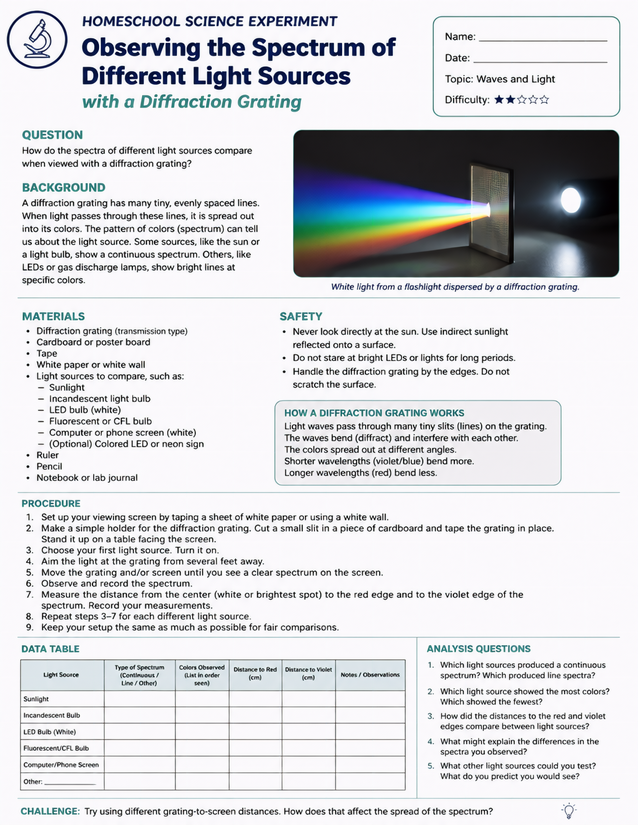
Compare the spectrum of different light sources using a diffraction grating in this homeschool science experiment for grades 5-8.
Recording Results for the Spectrum of Different Light Sources

Usage Notes
Most of the listed materials are household items: white paper or a white wall, tape, cardboard, a ruler, a pencil, and access to several light sources including a phone screen and incandescent or LED bulbs. The one specialty supply is a transmission diffraction grating, which is inexpensive but must be ordered ahead of time. The sheet includes three safety reminders: never look directly at the sun, avoid staring at bright LEDs for extended periods, and handle the grating by its edges to prevent scratching.
Printing Tips
Standard 20 lb copy paper works for this lab because students write measurements in centimeters rather than pressing hard with pencil. Slip the sheet into a lab notebook alongside the background reading, or use a clipboard so your student can move freely between light sources without losing their place in the procedure.